
The Villa is No Longer a Villa: Reading Qatar’s New Regulations
The recent amendments to Qatar’s villa and palace regulations mark more than a technical adjustment to heights, setbacks, annexes, majlis buildings, and mezzanine floors. They signal a deeper shift in how the Qatari home is being imagined through regulation.
The older villa regulations produced a specific urban object: a detached house surrounded by setbacks, placed within a walled plot, and organized through the logic of separation. The new regulations, by contrast, allow more occupation of the plot, greater verticality, expanded annexes, larger external majlis structures, internal family suites, reduced setbacks, and higher boundary walls. In doing so, they begin to blur the line between villa, compound, courtyard house, and multi-generational family home.
The question, then, is not only what changed in the regulations. The larger question is: after these amendments, does it still make sense to call this housing type a villa?
In the article Salman and I wrote in 2021, The Villa in a Khaleeji Context, we argued that the villa was never a neutral housing type in Qatar. It was not simply a house that people happened to prefer, nor was it an inevitable result of modernization. It was a form that became normalized through a combination of oil-era prosperity, imported planning models, changing social aspirations, and most importantly, design control regulations.
The villa entered the Khaleeji urban landscape as a promise of modern life. It represented comfort, status, privacy, and departure from the older urban fabric associated by many with poverty, overcrowding, and pre-oil hardship. In that sense, the villa was not only architectural. It was symbolic. It was the built form of a society moving outward from the dense historic town into the planned suburb.


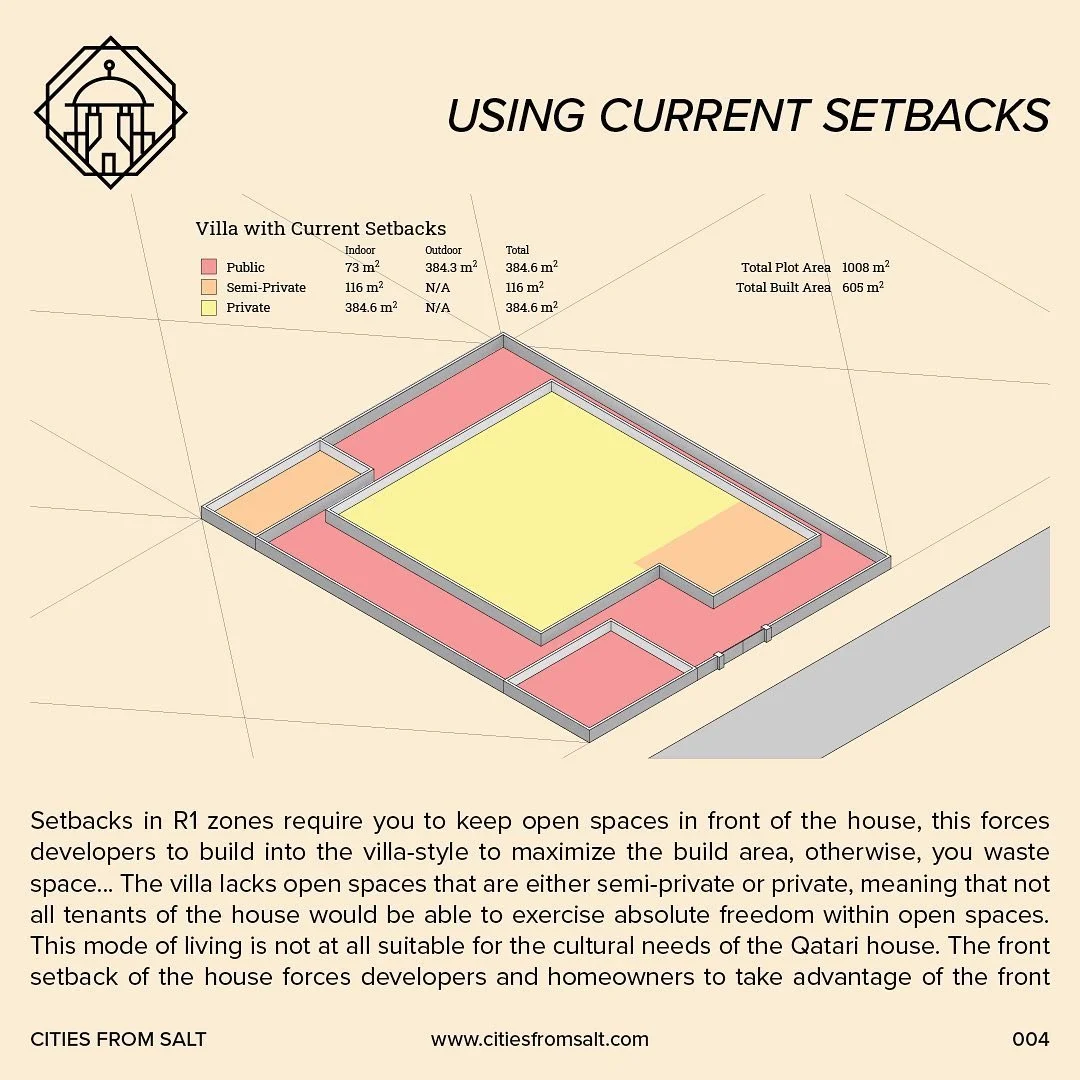


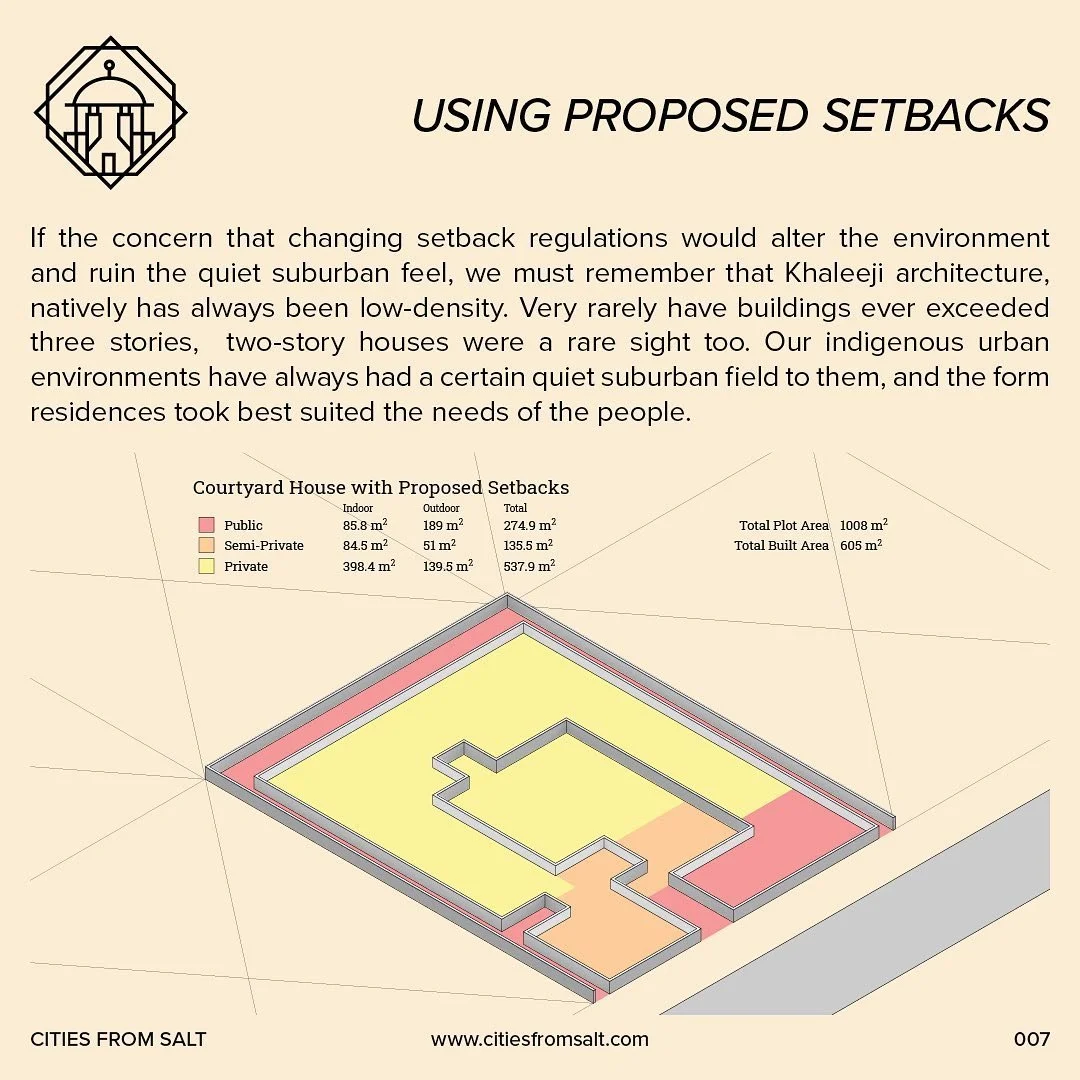


But what we tried to show in that article was that the dominance of the villa was not only cultural. It was also regulatory. The rules themselves made the villa the most efficient and logical outcome.
The old residential regulations treated the house as a detached object placed within the middle of a plot. The plot was divided through setbacks: front, sides, and rear. The building was allowed to occupy a certain percentage of the land, but it had to pull away from its edges. In theory, this produced order, separation, light, ventilation, and offered a sense of security and privacy which is important to Qatari society. To the planning body, it produced a recognizable low-density residential character. In practice however, it produced the familiar Qatari villa condition: a main mass surrounded by leftover strips of space, enclosed by a boundary wall.
That open space produced by the setbacks was compromised when studied under the lens of Qatari sociocultural and spiritual understanding of privacy. The spaces in between were often not truly public, not fully private, and not always useful. The front setback became a zone of gates, cars, paving, and ornamental landscaping. The side setbacks became service corridors, air-conditioning zones, storage edges, or simply unusable gaps between the house and the wall. The rear setback sometimes became a private garden, but even this was often shaped by the placement of annexes, kitchens, service rooms, and external circulation.
In other words, the old villa regulations produced openness, but not necessarily meaningful open space.
This was one of the central observations in the earlier article. The courtyard house did not lack open space. It organized open space differently. Its open space was internal, protected, shaded, and socially legible. It allowed the home to maintain privacy while still producing a usable outdoor room. The villa, by contrast, pushed open space to the edges of the plot. The yard became residual rather than central. The difference is important. In the courtyard house, the building protects the void. In the villa, the setback surrounds the object. In that sense they are polar opposites when mapping what is built and what is open.
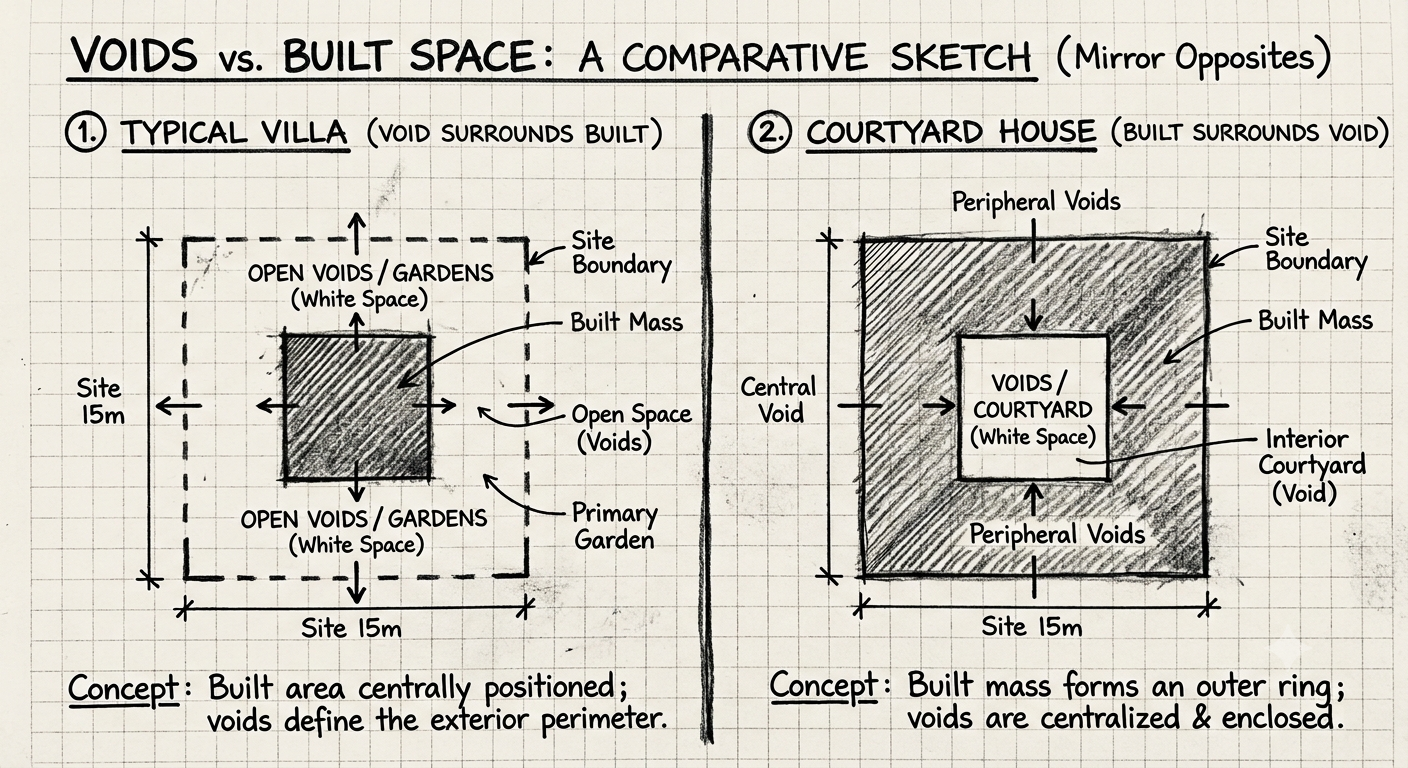
Generated via ChatGPT.
This distinction also emphasizes that while both forms of massing produce “privacy”, the meaning of privacy differs. In the traditional courtyard house, privacy was layered. There were transitions between the street, the entrance, the guest areas, the family spaces, and the most private parts of the home. Privacy was not created by total isolation but through sequencing differently programmed spaces within the depth and orientation via controlled visibility. The villa however, produces a binary understanding of privacy, because privacy in the Islamic urban context operates on a spectrum.
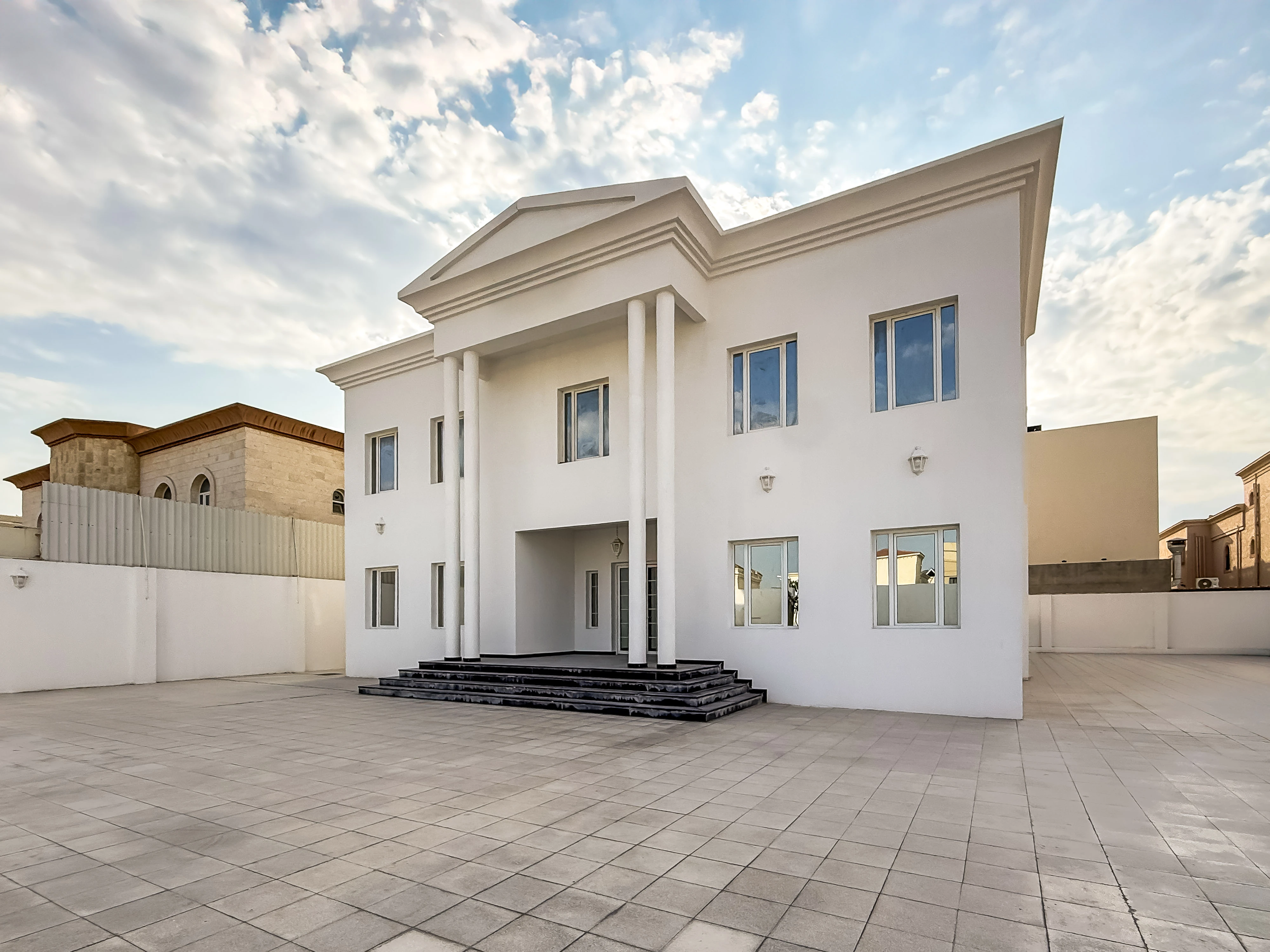
Notice the heightened barriers over the wall due to a lack of privacy in the home’s open spaces. Listed home for sale in Doha’s suburbs. (FGRealty)
In Qatar, the villa turned privacy into enclosure. The family home became a private object hidden behind a wall. The moment one leaves the wall, one enters the public realm. The subtle gradations between public, semi-private, and private space became harder to maintain. This is why Salman and I argued that the villa did not fully accommodate the cultural needs of the Qatari home. It provided privacy, but often in a blunt way.
The old regulations also assumed a particular domestic model. They treated the villa as a single main house with supporting elements: a majlis, annex, kitchen, service rooms, parking, and boundary walls. But Qatari domestic life is rarely so simple. The house is not only a nuclear family dwelling. It is often a multi-generational place, a site of hospitality, a service environment, a space for gendered reception, a place for elderly parents, married children, domestic workers, drivers, guests, and extended kinship. The villa had to absorb all of this complexity, but the regulatory form did not always allow it to do so gracefully.
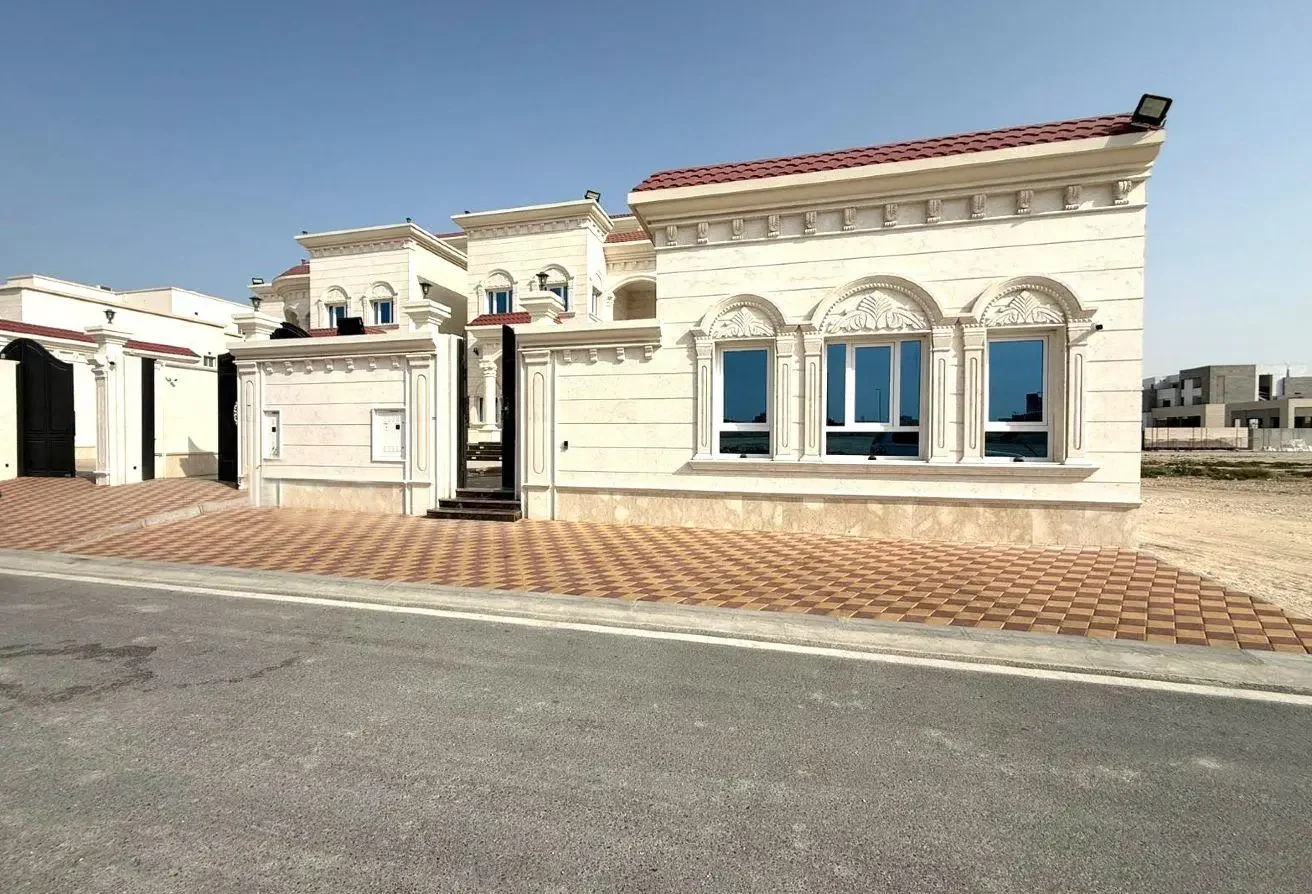
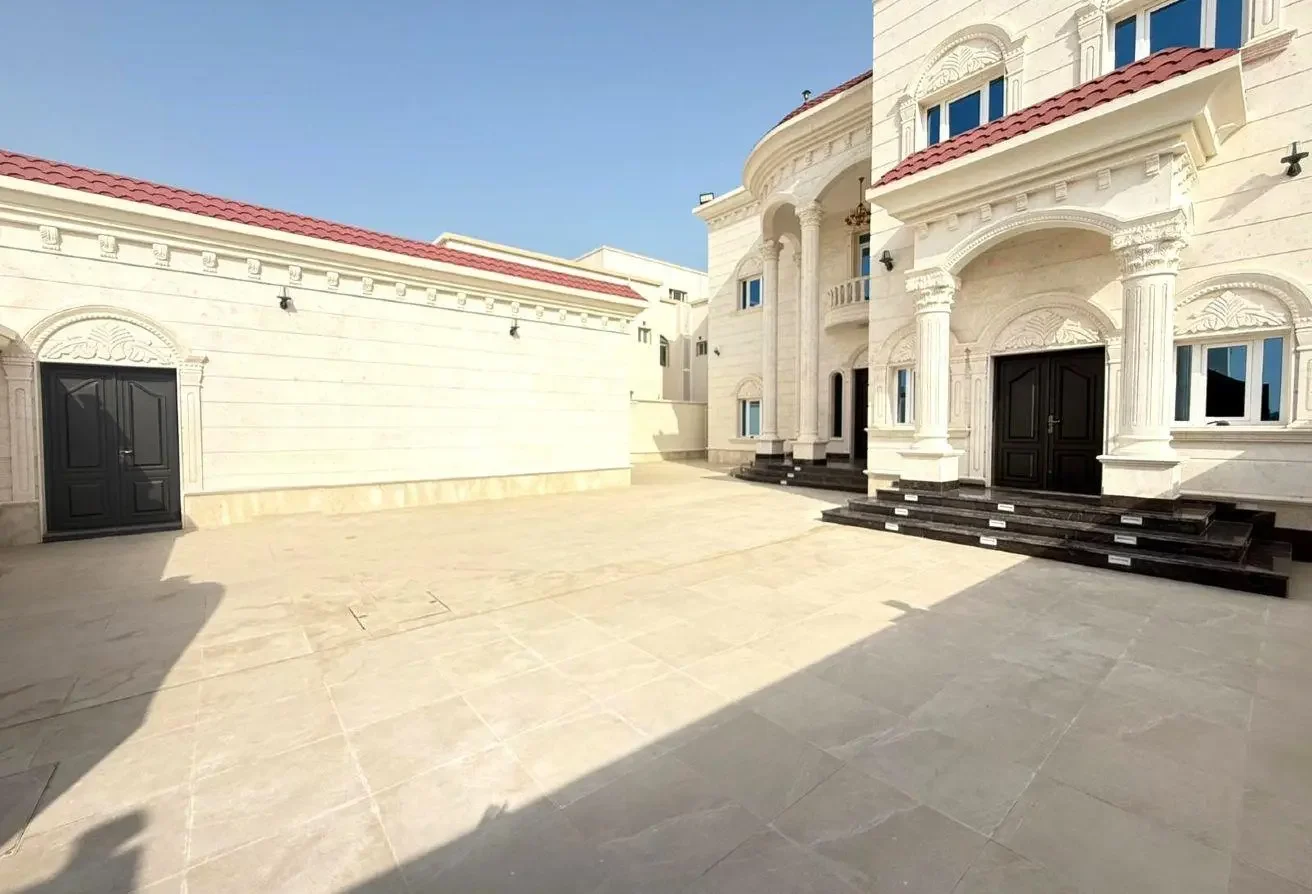
So, the villa was appropriated and adapted. We extended. We enclosed spaces. We added annexes. We raised walls. We converted setbacks (sometimes illegally). We built external majlis spaces. And in some cases, created informal separations inside the house.
These adaptations were not accidental. They were signs that the villa, as a detached imported object, was being asked to perform social functions it was not originally designed for. This is why the old regulations matter. They did not simply control buildings. They produced a way of living. By requiring setbacks and encouraging a detached massing, they made the villa more practical than the courtyard house. They rewarded the object in the middle of the plot and made inward-facing domestic forms harder to achieve without sacrificing built area.
The result was a residential landscape that became visually familiar across Doha: large villas, high walls, paved setbacks, external majlis buildings, service annexes, and streets lined more by boundaries than by homes.
The old villa was therefore a contradiction.
It was culturally adopted, but architecturally foreign. It promised privacy, but often weakened the layered privacy of older domestic traditions. It created open space, but frequently in the least usable parts of the plot. It offered status and modernity, but at the cost of spatial forms that were more climatically and socially responsive to the region.
This is the starting point for understanding the recent regulatory updates. The new rules do not emerge from nowhere. They respond, directly or indirectly, to the limits of this old model. They acknowledge that the Qatari home needs more flexibility, more internal complexity, more space for family growth, more room for hospitality, and more capacity to adapt over time.
At first glance, the updates may appear technical, but taken together, these changes matter because they change the relationship between the house and the plot boundaries. This raises one central question to those of us who champion the courtyard home: can the villa begin to operate less as a detached object and more as an inward-facing home?
In other words, do the new regulations make the courtyard house possible again, or do they only produce a denser villa?
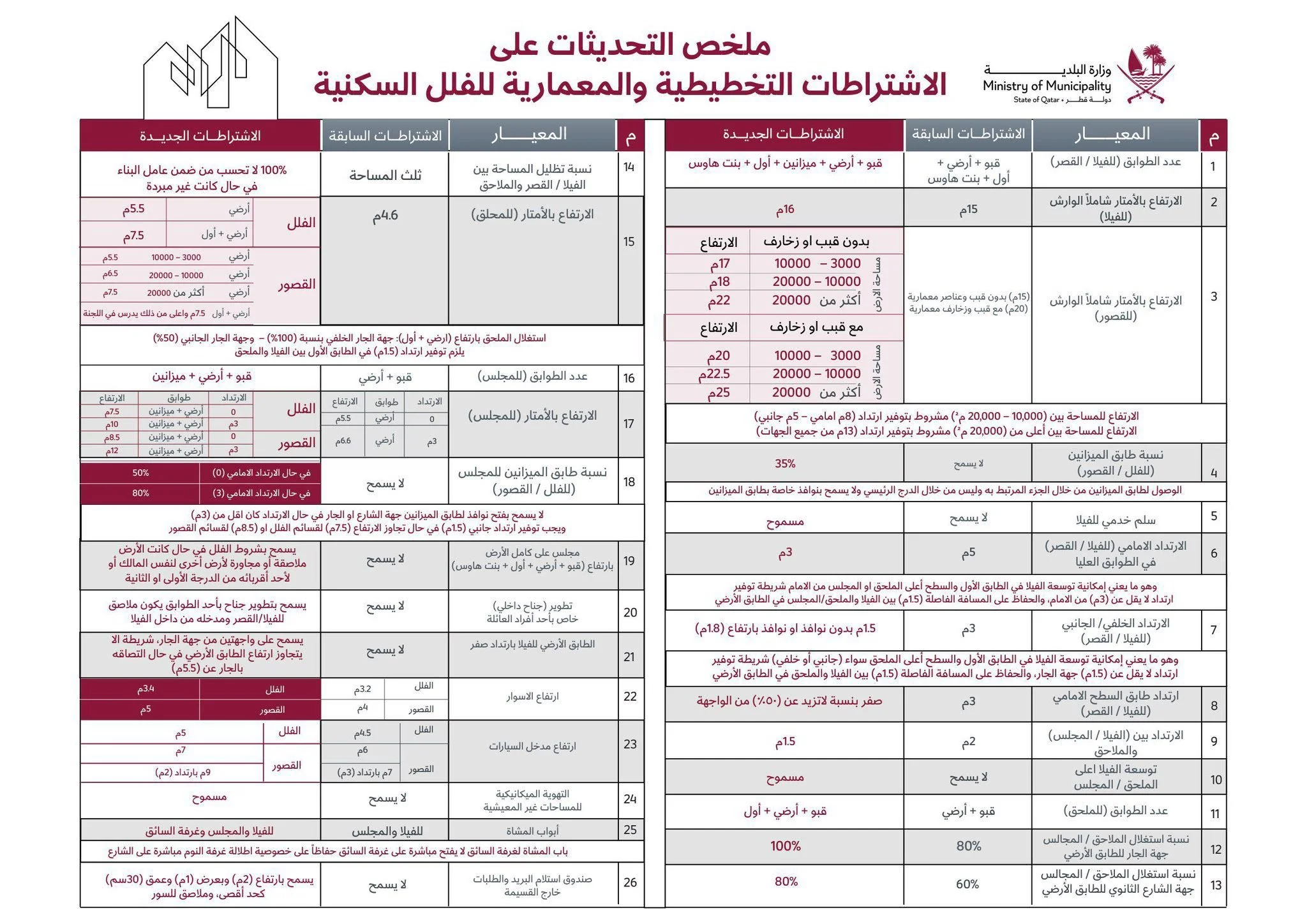
A summary of the old and new regulations.
To answer this, it is useful to read the regulations through two lists: four things that changed, and four things that did not.
What Did Not Change
The first thing that did not change is the floor area ratio. The FAR remains 1.65. This means that the total buildable floor area is still controlled by the same overall development intensity. The new regulations do not simply allow unlimited expansion. They reorganize how that allowable area can be distributed within the plot. This is important because the courtyard house is not only about building more, it is about placing the built form differently.
The second thing that did not change is the maximum built coverage, which remains 60%. This means that 40% of the plot must remain unbuilt at the ground level. In theory, this could support the creation of a courtyard. A courtyard needs open space, and the regulation already requires that a significant portion of the plot remains open. Under the older villa logic, open space was often pushed to the edges of the plot through setbacks. It appeared as front yards, side gaps, service corridors, and leftover rear spaces.
The third thing that did not change is the 5-meter front setback for the ground floor of the main villa. This is one of the most important continuities. The front setback preserves the suburban image of the villa as a house pulled back from the street. It keeps the main building from directly defining the public edge. From the perspective of courtyard housing, this matters. A traditional courtyard house does not usually operate as an object set back from the street. It often uses the built edge to define the street while turning inward for light, air, privacy, and social life.
The fourth thing that did not change is that 60% of the facade of the front ancillary building, or majlis, may be built on a 0-meter front setback. This is a critical exception. While the main villa must remain set back, the majlis is allowed to meet the street more directly.
What Did Change
The first major change is the ability to build the ground floor of the villa on a 0-meter setback along two neighboring plot boundaries. This is perhaps the most significant shift for anyone interested in courtyard housing. The older villa logic required the house to pull away from its edges. The new regulation allows the house, under specific conditions, to touch two sides of the plot. This changes the massing logic entirely. The villa no longer has to sit as a detached object surrounded by leftover strips. It can begin to form a perimeter. It can protect an internal open space. It can define a more private domestic world from within the plot.
The second change is that bathrooms and kitchens are allowed to rely on mechanical ventilation. This may sound minor, but spatially it is important. When every bathroom and kitchen requires direct natural ventilation, the plan becomes more difficult to compact. Wet areas need access to external walls or shafts, which can fragment the layout and make inward-facing arrangements harder. By allowing mechanical ventilation, the regulations give designers more freedom in plan-making. Service spaces can be placed deeper within the building. This makes it easier to organize rooms around an internal courtyard, to create thicker building masses, and to reduce the dependence on external setbacks for ventilation.
The third change is the new flexibility given to the penthouse level, where 50% of its frontage can follow the same setback line as the floor below. This may sound like a small technical adjustment, but it has important consequences for massing. Under the older logic, the uppermost floor was more visibly set back, which reinforced the image of the villa as a stepped object sitting within the plot. By allowing part of the penthouse frontage to align with the floor beneath it, the new regulations make the upper mass more continuous.
The fourth change is the ability to extend the upper floors of the villa above ancillary buildings. This is another important move away from the detached object. The upper levels of the villa can now bridge, overlap, and connect with parts of the plot that were previously treated as separate. This produces a more continuous massing. It allows the house to use the plot more efficiently and to create shaded areas, covered transitions, and layered relationships between the main villa and its supporting buildings. It also makes it possible for the home to develop as a more complex family structure, with different zones connected vertically and horizontally.
Four Implications
Read together, these two lists show that the new regulations do not fully abandon the villa model. The FAR remains the same. The built coverage remains the same. The main villa still keeps its 5-meter front setback. The regulation still distinguishes between the villa, the majlis, and the ancillary buildings, but the changes begin to loosen the old detached-object logic. The house can touch the sides, service spaces can move inward, ancillary buildings can rise, and upper floors for the main residence can extend across them. This produces four important implications.
The villa no longer has to behave as a freestanding object in the middle of the plot. By allowing the ground floor to be built on a 0-meter setback along two neighboring boundaries, the regulation allows the house to become part of the plot’s edge condition. This is a major spatial shift, as it allows the villa to act less like an object surrounded by leftover setbacks and more like a perimeter form. The building itself can help define privacy, enclosure, and internal open space.
The new regulations make a courtyard-like home more possible, but they do not guarantee it. A courtyard is not simply an empty space inside a plot, it is an intentional spatial device. It organizes light, air, privacy, circulation, family life, and social hierarchy. The unchanged 60% built coverage still requires 40% of the plot to remain open at ground level. But that open area can still become a front yard, a parking court, a side gap, or a service zone. The regulation creates the possibility of a courtyard, but the design decision determines whether the open space becomes meaningful. In other words, the new rules allow the void to move inward, but they do not require it to become the heart of the house.
The majlis becomes even more important, because 60% of the front ancillary building’s facade can still be built on a 0-meter front setback, while the main villa remains set back by 5 meters at the ground floor, the majlis occupies a special position. It can define the street edge more directly than the family house. This makes sense socially, as the majlis has always operated as a threshold between the household and the outside world. It has always allowed the family to engage with society without exposing the private interior of the home. Under the new regulations however, the majlis also becomes an urban device. It can help repair the street edge that the detached villa weakened. It can create a more defined frontage. It can also participate in shaping the internal courtyard, especially if its upper floor or relation to the main villa is carefully designed.
The new regulations open two very different futures. On the one hand, the regulations can be used to produce heavier villas. The regulations allow for larger masses through taller ancillary buildings, since ancillary buildings can now have an additional floor. The regulations also allow for more enclosed plots, higher walls, and more built-up residential neighborhoods. In this scenario, the villa becomes denser, but not necessarily better. The result is a more crowded version of the same detached-object logic. On the other hand, the regulations can be used to rethink the Qatari home. The house touches the boundary not only to gain area, but to protect an internal courtyard. Mechanical ventilation gives flexibility to service spaces, while main rooms are oriented toward shaded internal open space. Ancillary buildings help define the void rather than clutter the plot. Upper floors extend strategically to create shade, enclosure, and layered family spaces. This second future is where the regulations become most interesting. They do not revive the courtyard house directly, but they create the regulatory conditions for a new courtyard logic to emerge.
Looking back at our 2021 article, Salman and I tested the old villa regulations through massing studies. The idea was simple: using the dimensions of a typical R1 Plot from Qatari housing projects, 28m by 36m, and the relevant design control regulations, could we produce a courtyard house?
What we found was that the old regulations produced a villa as the easiest and most logical solution. The house sat in the middle of the plot surrounded by setbacks on all sides. The open space produced by the regulations existed on the periphery of the building as front yard, service edges and leftover strips between the main residential unit and the boundary wall. Under a Qatari sociocultural lens, we argued that the outdoor space produced via these regulations were useless to the inhabitants of the home.
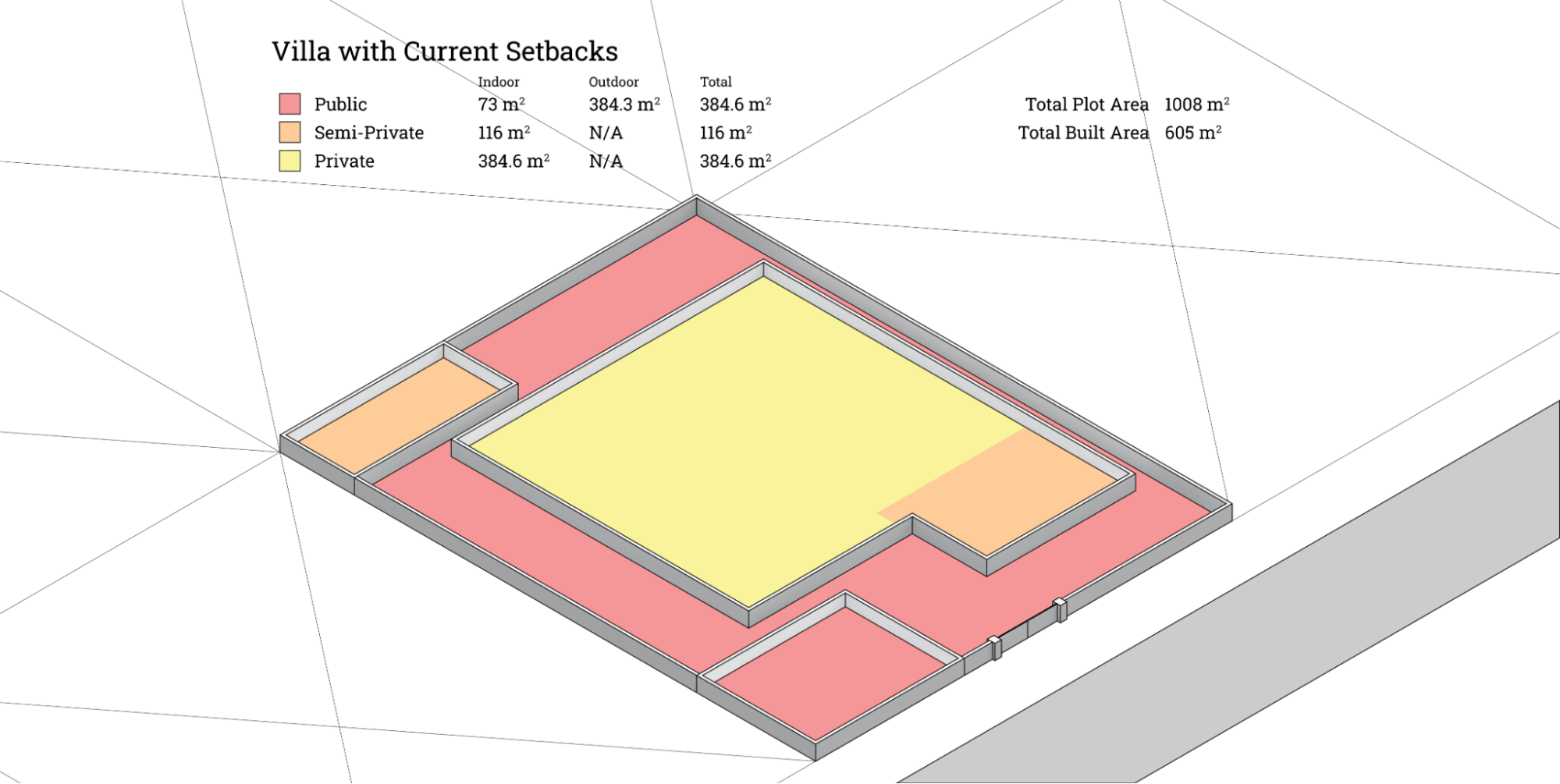
2021 Illustration. Showing a Traditional Villa with the Old Regulation Setbacks.
We also decided to brute force a courtyard home layout while still maximizing the built area, to illustrate the fact that the blame is not only on bad copy and paste architecture, but the invisible hands of the building regulations. What we found was that the regulations still pushed the building away from the plot edges, which meant that the courtyard struggled to become the organizing heart of the home.
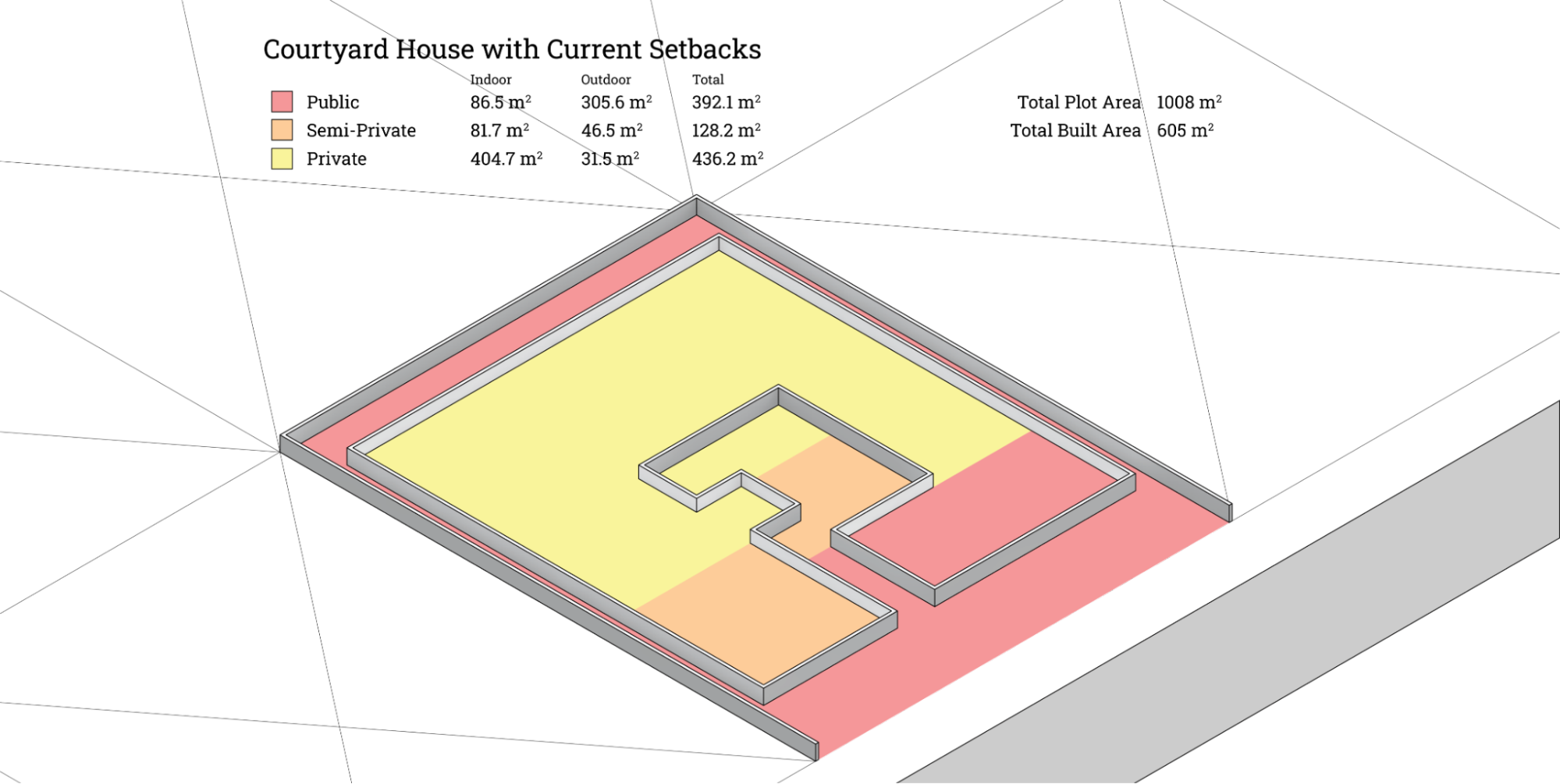
2021 Illustration. Showing an Attempt at a Courtyard House with the Old Regulation Setbacks.
So, can we build a courtyard house again?
In short, yes, but with important qualifications. We’ve illustrated every step to explain the logic and how the massing was achieved in line with the new regulations and dive into why it has become possible, what challenges still exist.
Step 1: The Setbacks
As illustrated, the biggest difference for courtyard house designs is the ability to build the ground floor of the villa on a 0-meter setback along two neighboring plot boundaries. This is the regulation that most directly challenges the old detached-villa model. Of course, this does come with the caveat that the ground floor should not exceed 5.5 meters which is very reasonable.
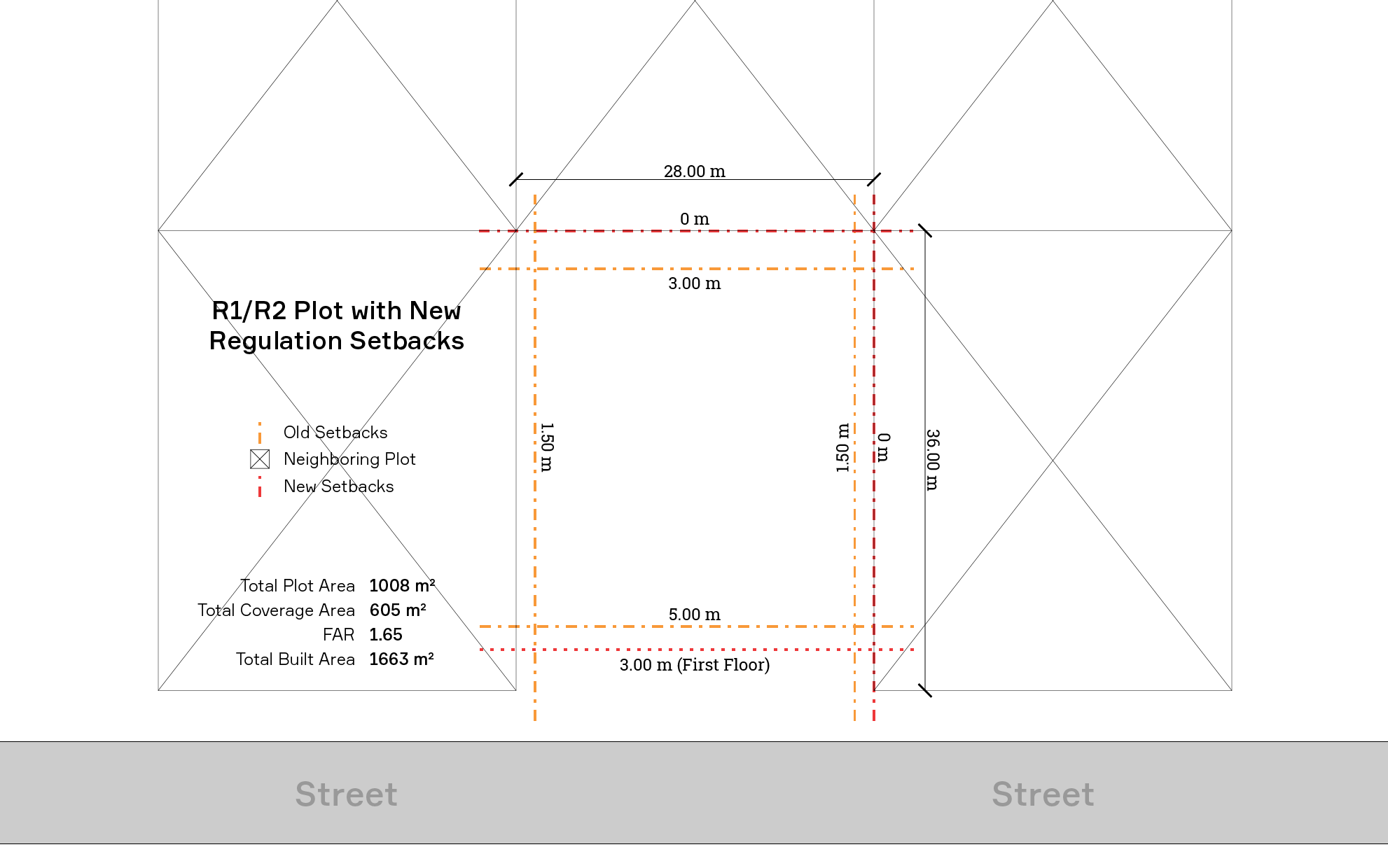
2026 Illustration. R1/R2 Plot with New Setbacks.
Previously, the house had to pull away from its edges. Now, at least on the ground floor and under specific conditions, it can touch two sides of the plot. This allows the building to become part of the plot’s perimeter. Instead of relying only on the boundary wall to produce privacy, the house itself can begin to define the private interior. However, it is important to note that the front setback for the main residential unit is 5 meters, but in the following section we discuss how in spite of that, via ancillary buildings a logical courtyard solution can be designed.
On the first floor, the setbacks begin to differ. The new regulations require a 3 meter setback from the front and a 1.5 meter step back from the neighboring plot, and the regulations now explicitly allow the repeating floors to be built and extend on top of any ancillary buildings.
Step 2: The Ground Floor
The ground floor is where the courtyard logic becomes most visible.
Using the new regulations we are able to build the full length of 2 neighboring plots with a 0-meter setback. The front edge can be partially defined by the majlis, since 60% of the front ancillary building’s facade may still be built on a 0-meter front setback. The remaining side can be occupied by an ancillary building, such as an external kitchen or service structure, within the allowed coverage.
Together, these three elements: the main house, the majlis, and the ancillary building, begin to form a perimeter around an internal open space.
In the illustration below you can see that this produces a private courtyard of approximately 344 square meters. On a plot of around 1,008 square meters, this means that roughly one third of the plot can become private outdoor space. This is a major shift from the old villa logic, where outdoor space was distributed around the edges of the house and often became residual.
The significance here is not only the size of the courtyard. It is the location of the open space. The open space becomes the spatial center of the home. It can be protected, shaded, overlooked by rooms, and used as an outdoor domestic room. This is the first moment where the new regulations begin to make a courtyard logic possible.
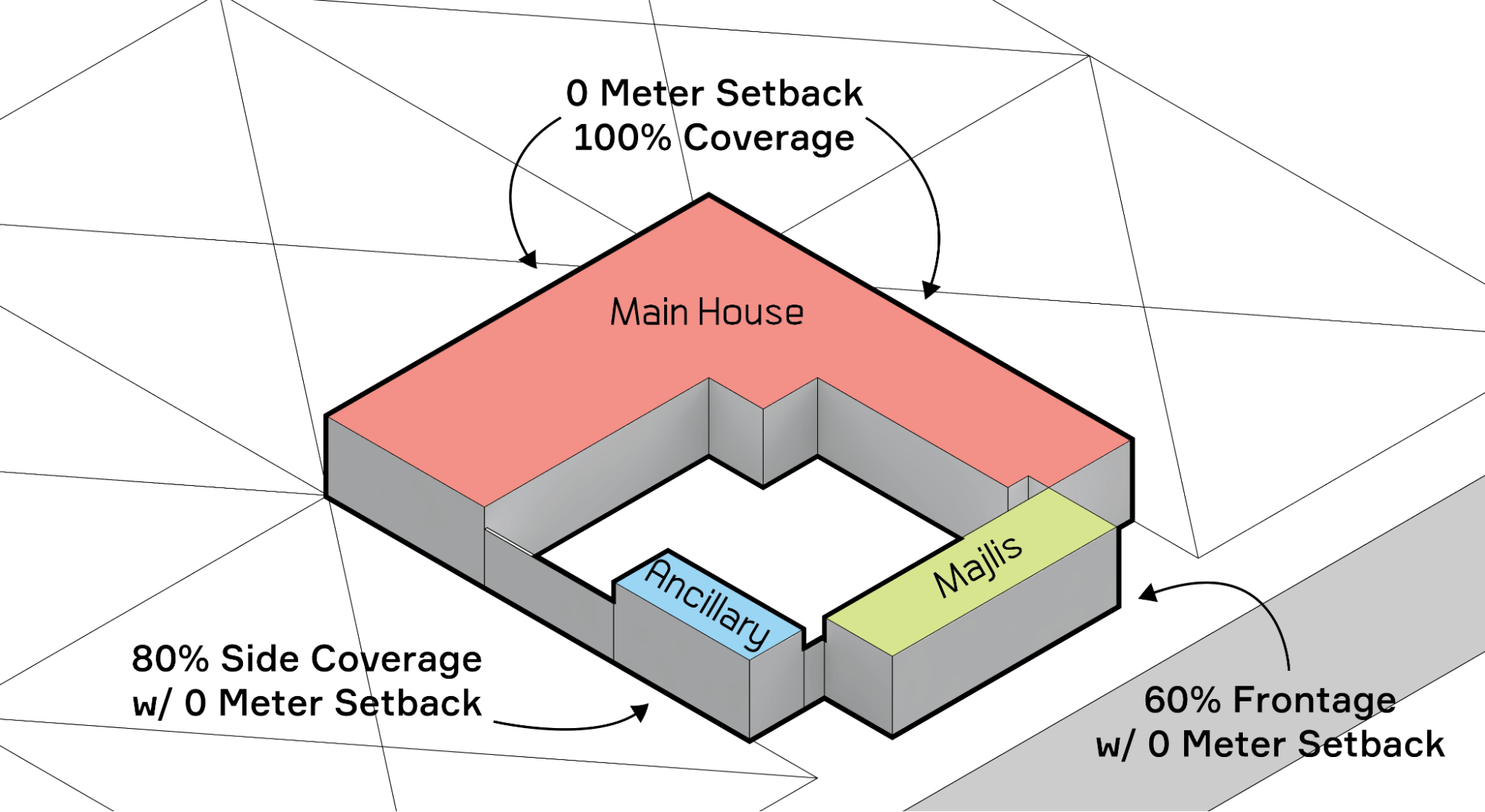
2026 Illustration. Showing the Ground Floor Massing with the Setbacks and Coverage Percentages per the New Regulations.
Step 3: The First Floor
The new allowance to build above the ancillary buildings and the majlis is arguably the most important change in achieving a successful courtyard house.
This allows the house to become more continuous. The upper floor can bridge, overlap, and connect parts of the plot that were previously treated as separate structures. This matters because a successful courtyard house depends on enclosure. The courtyard needs edges. It needs walls, rooms, galleries, or built masses that define it. If the ground floor begins to create the courtyard, the first floor can complete it.
In the illustration below, we surround the courtyard more fully while still respecting the new setbacks. This produces a more private internal space, especially in relation to neighboring plots. The courtyard is no longer exposed as a gap between separated buildings. It becomes a protected interior condition
Of course some details while spatial planning need to be worked out through real and thorough design. Window placement, sill heights, overlooking, service organization, and internal circulation would all affect the final plan. But at the level of massing, the shift is clear: the villa can now become more layered, more inward, and more spatially continuous.
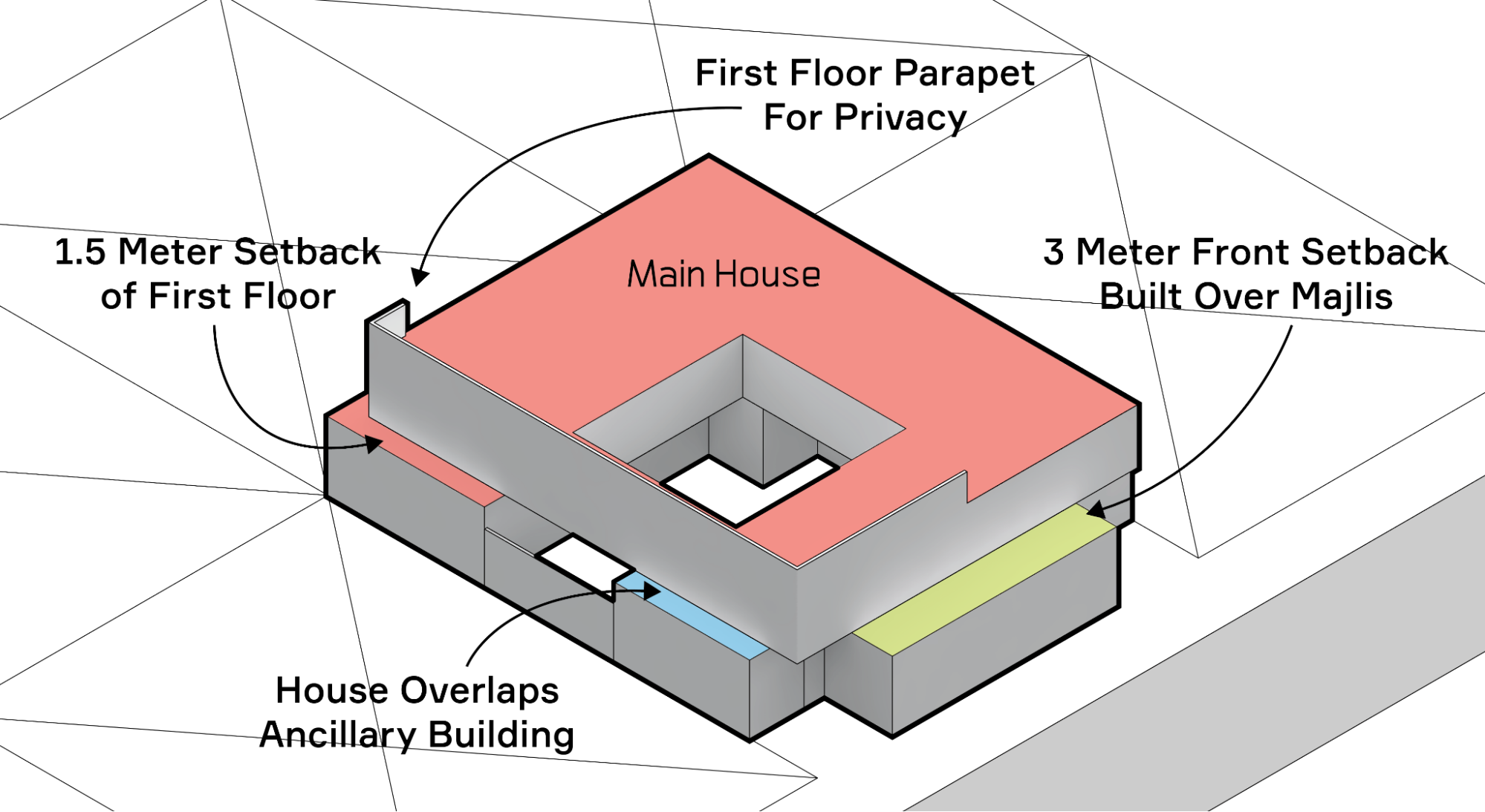
2026 Illustration. Showing the Massing of the First Floor with New Regulations Highlighted.
Step 4: The Penthouse
The final piece of regulation change is in the penthouse.
With the new allowance for 50% of the penthouse frontage to be built without setbacks, the upper massing can continue to hold parts of the plot edge while maintaining the courtyard or light well below. This allows the house to grow vertically without entirely abandoning the internal void.
This is important because the contemporary Qatari home is under pressure to accommodate more functions, more family members, more privacy requirements, and more service needs within the same plot. The penthouse regulation allows additional area, but it also raises a design question: will that area be used to strengthen the courtyard logic, or simply to add bulk?
Used carefully, the penthouse can support shaded terraces, upper-level family spaces, and visual relationships with the courtyard below. Used carelessly, it can simply become another layer of mass added to an already heavy building.
Overall these changes - although not completely in favour of courtyard houses - can get you pretty close to a great contemporary courtyard house (in theory).
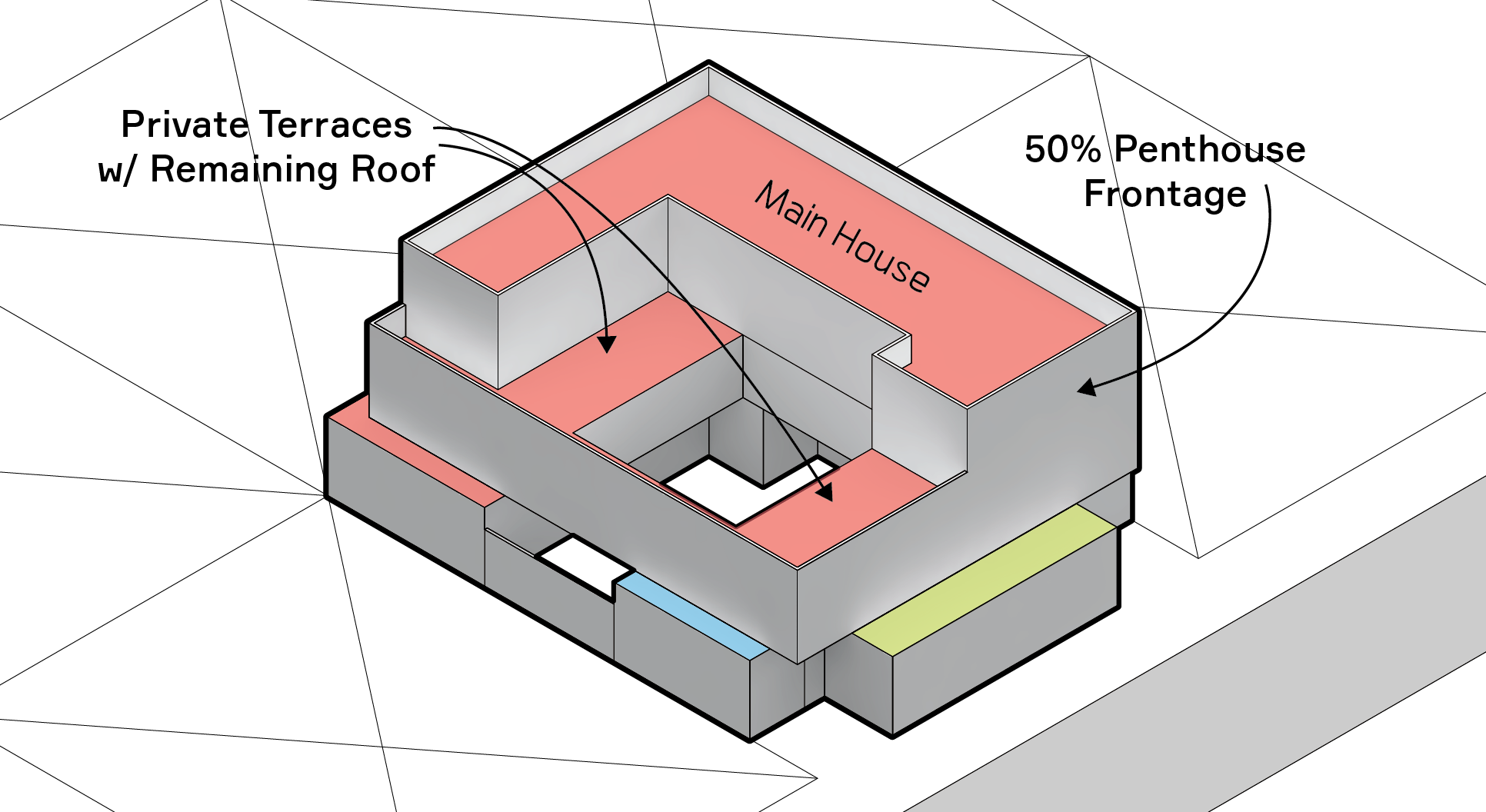
2026 Illustration. The Penthouse with Allowance for 50% Frontage without Setbacks.
What the Massing Studies Show
Between the 2021 massing and what we achieved using today's guidelines the differences are immense.
Under the old regulations, the villa was easiest to design as an object in the middle of the plot. The courtyard house was possible only through compromise. Under the new regulations, the courtyard becomes much more plausible. The house can touch the plot edge. The majlis can define part of the frontage. The ancillary building can help complete the enclosure. Upper floors can extend across supporting structures. The courtyard can become central rather than residual.
Most notably, when compared to the 2021 massing per old regulations, the amount of private outdoor space can increase by almost ten times compared to what was previously possible. Within the illustration, you will find that the entrance to the villa, as well as the ancillary building has been defined as semi-private, but, depending on how those spaces open to the courtyard, portions of the courtyard could also be defined as semiprivate
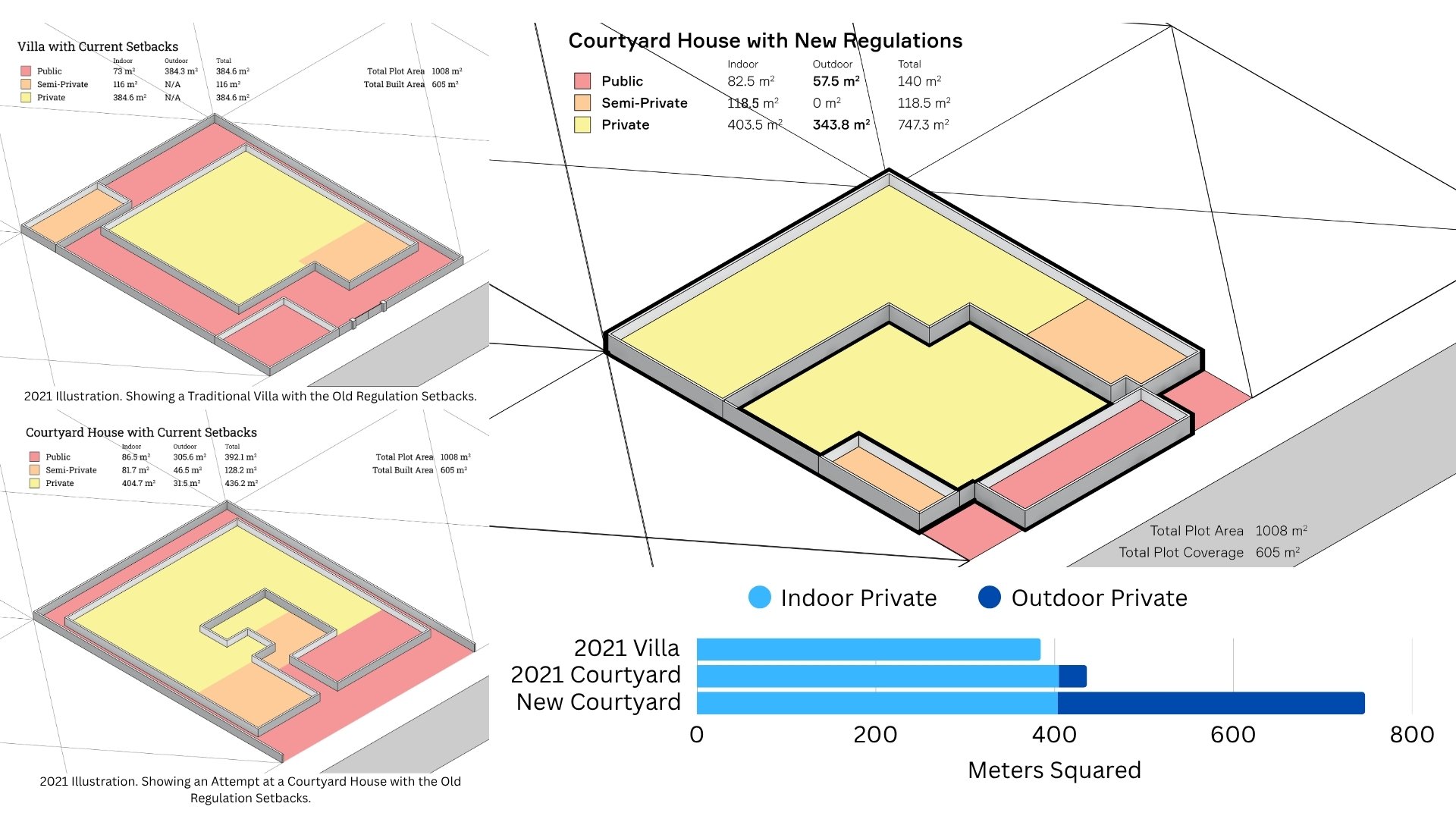
2021 and 2026 Illustrations. A Comparison of the Indoor and Outdoor Private Spaces.
The massing study also shows the limits of the new regulations.
First, the main villa still cannot fully merge with the majlis and ancillary buildings in the way a true courtyard composition might require. Where gaps are still required, the house remains partly fragmented. This limits the ability to create a fully continuous perimeter around the courtyard.
Second, the 5-meter front setback remains one of the biggest obstacles. It preserves the suburban image of the villa as a house pulled away from the street. If the purpose of the front setback is parking, then perhaps parking should be regulated directly rather than through a plot-wide spatial requirement. Otherwise, the regulation continues to produce residual front space even when the rest of the plot is moving toward a more inward logic.
Third, the second floor of ancillary buildings is a double-edged sword. It can be used creatively to define the courtyard, create shade, and accommodate family or service functions. But it can also produce large warts along the edges of plots, creating heavier and less coherent residential environments.
If we read the new regulations only as permission to build more, then the villa will simply become larger and denser. But if we read them as an opportunity to reorganize domestic space, then they may mark the beginning of something more interesting: a contemporary Qatari courtyard logic, emerging from within the villa regulations themselves.
Not exactly, but it has taken a new life of its own. In our 2021 article, we emphasized that the villa had to be appropriated constantly to fit Qatari society’s needs. In that sense, the contemporary villa in Qatar was never a villa to begin with.
The villa as a term is too embedded in Qatar’s residential imagination, real estate market, regulatory language, and social vocabulary to disappear so easily. Families will still say they live in a villa. Real estate listings will still advertise villas. Regulations will still use the term. Municipal systems will still classify plots as villa plots. The word will survive, but what’s interesting to consider is whether the villa still describes the thing being produced.
If the villa originally referred to a detached house sitting within a plot separated from its neighbors and enclosed by a boundary wall, then the new regulations begin to stretch that definition. They do not abolish the villa, but they weaken the assumptions that made it legible as a villa in the first place. The villa can now touch the sides of the plot. Its service spaces can move inward. Its ancillary buildings can rise. Its upper floors can extend above those ancillary structures. Its majlis can become a stronger frontage. Its open space can, if designed carefully, move from the edges of the plot to its interior.
This is not the detached villa as we inherited it. It is something thicker, more flexible, more enclosed, and more spatially complex. The constant reappropriation of the villa through Qatari regulations mutated it into something else entirely.
This mutation matters because the villa was always slightly uncomfortable in the Khaleeji context. As Salman and I argued in the earlier article, the villa became dominant not because it perfectly matched local domestic life, but because it arrived at a moment when the Gulf was being rapidly replanned through oil wealth, imported planning models, suburban expansion, and new aspirations of modern living. It promised privacy, status, comfort, and land. But it did not necessarily reproduce the spatial intelligence of older courtyard houses, which organized family life around inwardness, climate, hierarchy, and carefully controlled thresholds.
The older courtyard house was not simply a house with an open space in the middle. It was a complete domestic system. It managed privacy without completely depending on boundary walls. It created outdoor space without exposing the family to the street. It allowed light and air to enter the home while keeping the public world at a distance. It placed the void at the center of domestic life. The villa reversed this spatial logic, it pushed open spaces outward instead of inward.
A courtyard house belongs to a wider urban world. It belongs to narrow streets, shared walls, shaded movement, compact neighborhoods, and a social order in which the house, street, and courtyard are part of one spatial system. If we take the courtyard out of that system and place it inside a suburban plot, we do not automatically revive the traditional courtyard house. We produce something else.
The house may still be called a villa, but it can now behave differently. It can use the building mass to define privacy instead of relying only on the boundary wall. It can gather rooms around an internal open space rather than leaving open space as a leftover condition. It can absorb the majlis, annex, service spaces, and family suites into a more deliberate spatial composition. It can become less of an object and more of an enclosure.
This is not the death of the villa. It is the emergence of the post-villa, a Qatari villa.
The post-villa is still located in the villa zone. It still sits on the villa plot. It still follows villa regulations. It still carries the social meaning of the villa as a family home. But spatially, it begins to depart from the detached suburban object. It becomes a domestic compound, a layered family structure, and potentially an inward-facing courtyard home.
However, this is purely theoretical. The same regulations that allow a courtyard logic can also produce bulkier villas, heavier streets, taller walls, more built-up plots, and more internalized homes that contribute little to the neighborhood. A house can touch the boundary without creating a courtyard. An annex can rise without improving domestic life. A majlis can define the street edge without creating a meaningful public frontage. A higher wall can protect privacy while further deadening the street. Regulations cannot fix bad design and bad architecture.
This is where design becomes critical. The courtyard cannot be treated as a decorative reference or nostalgic gesture. It has to be understood as a spatial principle. It is not a shape, but a relationship between built and unbuilt space, between privacy and openness, and between family and guest.
What is a bit humorous to consider, is that after nearly seventy years of Modernist planning and design sensibilities, and after the many spatial and social headaches it produced, our regulations appear to be slowly rediscovering a spatial logic that already existed in our society before Modernist planning arrived.
When viewed under that lens, I could only begin to imagine how many of our contemporary urban problems might be addressed by relearning the spatial intelligence embedded in our older building traditions.