
Shade as Public Infrastructure: Toward a Shading Network for the Khaleeji City
I often find myself in casual conversations with family and friends about the notion of walkability in the Qatari context. These conversations usually fall between two opposite positions. On one end are those who champion walkability and hope to see Qatar’s public realm become more pedestrian-friendly. On the other are those who see it as largely impractical because of the country’s climatic conditions.
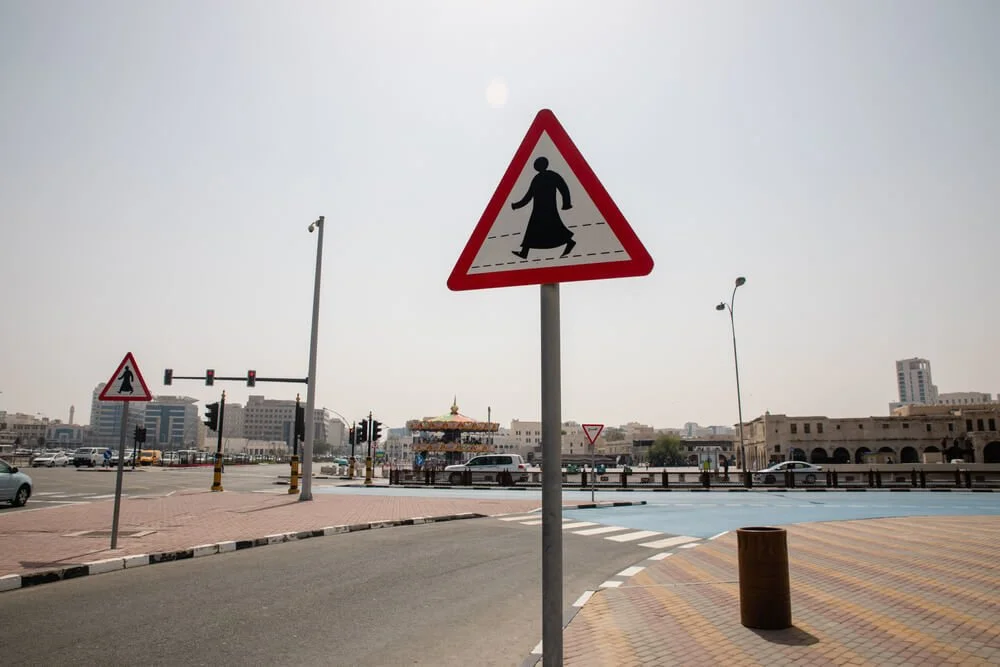
Pedestrian Crossing Sign, Doha, Qatar (Shutterstock)
Yet both sides tend to agree on one thing: heat is the central obstacle. For some, heat is the reason walkability cannot work. For others, it is the main challenge that must be solved before walkability can become realistic. In either case, the discussion often treats heat as a fixed condition, something that exists outside the scope of planning and design.
But my own experience as a pedestrian in Doha has led me to think about this differently. Very often, the issue is not heat in the abstract, but exposure. More specifically, it is the experience of walking under direct sunlight, across exposed pavement, with little protection from the radiant heat of the city around you. A short five-minute walk can feel unbearable when the route is fully exposed. The same distance under continuous shade can feel entirely different.
This distinction matters because outdoor comfort is not determined by air temperature alone. One useful concept here is Mean Radiant Temperature, it refers to the amount of heat the human body receives from its surroundings. This includes direct sunlight from above, reflected heat from bright or hard surfaces, and stored heat released by pavements, walls, and buildings. For pedestrians, this means that two streets with the same air temperature can feel completely different depending on their exposure to the sun, (as well as the materials used, the width of the street, the presence of trees, and the amount of shade available).
You can read more about Mean Radiant Temperature and its implications on urban planning and design through this excellent paper: https://www.sciencedirect.com/science/article/pii/S0360132326004002.
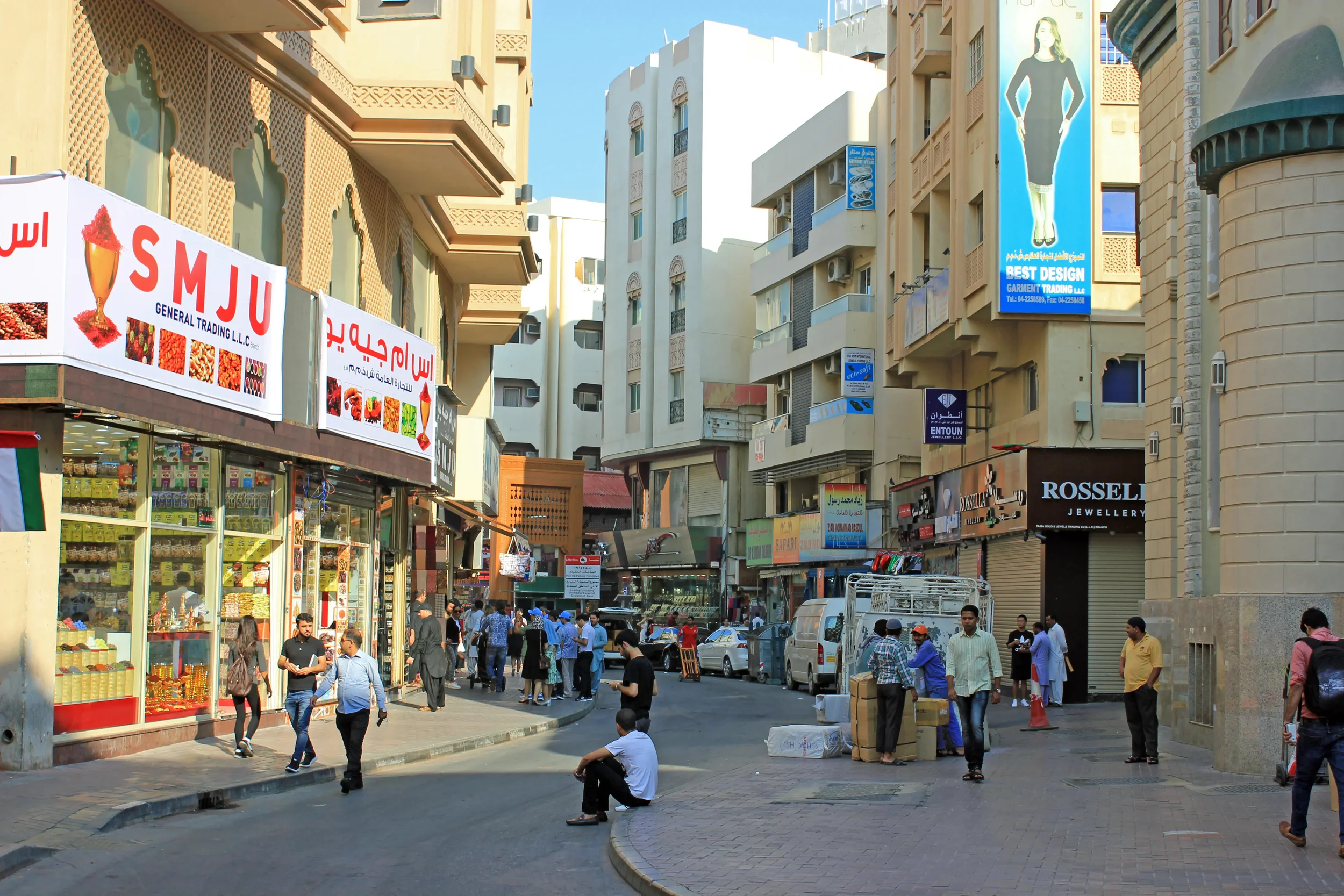
Deira, Dubai, UAE (Liberal Landscape)
This is why shade is so often understated in discussions of walkability, particularly in hot-climate cities. A shaded street is not simply more pleasant because it is visually softer or more comfortable in a general sense. It changes the thermal experience of walking. Studies in hot desert environments, like in Tempe, Arizona, have shown that shade is one of the key factors in making pedestrian spaces more comfortable, with both tree shade and built shade reducing heat stress and improving people’s perception of outdoor comfort.
Under exposed pavement, especially in the Gulf, a sidewalk may exist physically but fail functionally. It may be mapped as pedestrian infrastructure, paved to the correct width, and connected to surrounding uses, yet still remain uncomfortable or underused because it offers no protection from the sun. In hot climates, walkability cannot be reduced to distance, land-use mix, or sidewalk provision alone. It must also be understood through thermal comfort.
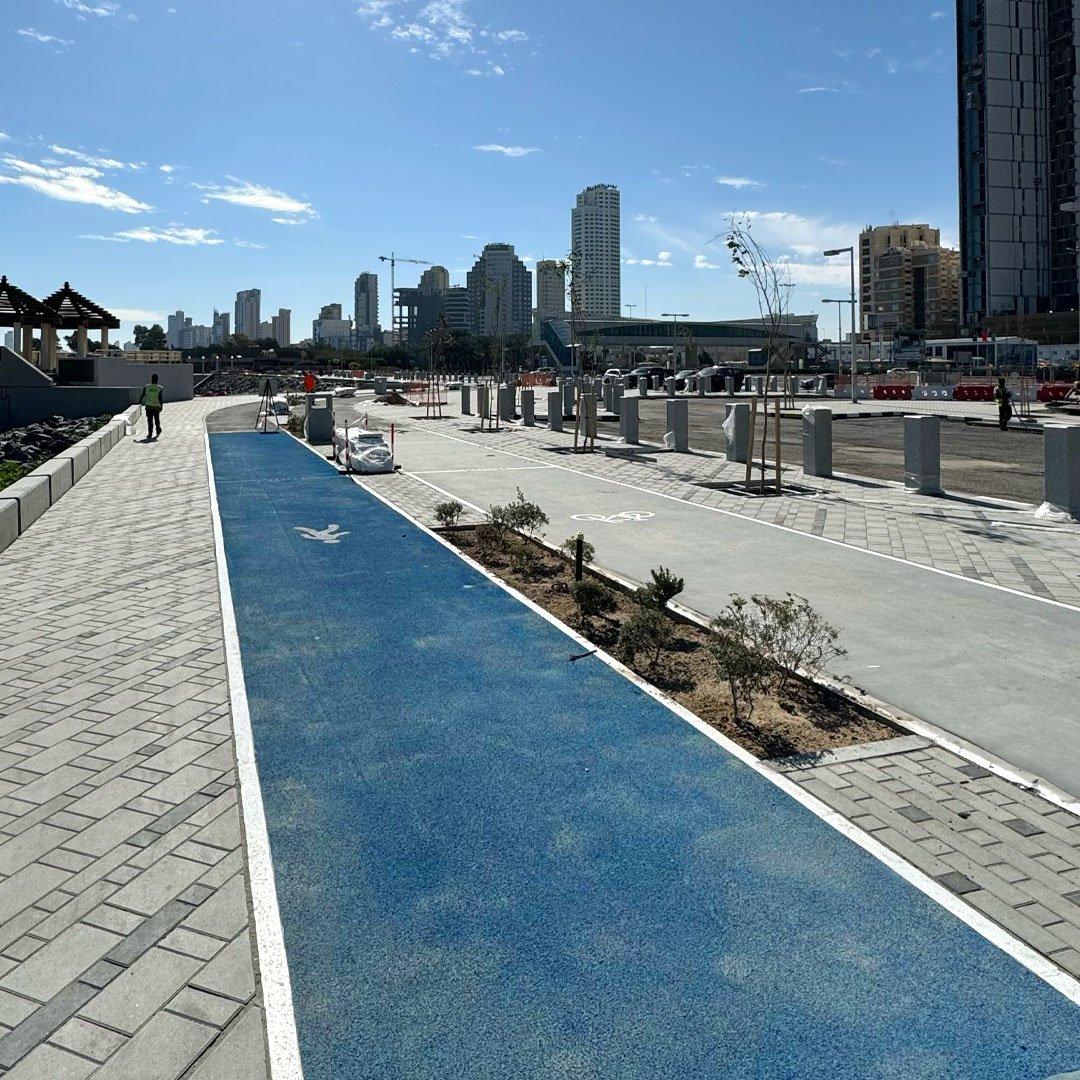
Gulf Road, Kuwait City, Kuwait (2:48AM)
We often treat shade as an architectural feature or a landscape detail, we treat it as a matter of beautification. But in arid and hot-climates, shade performs the same role as other forms of infrastructure: it enables access, protects health, supports mobility, extends the usability of public space, and makes urban life possible.
In that sense, shade should be treated as public infrastructure. Like street lighting, drainage, benches, crossings, and transit stops, shade enables the city to be used. It allows people to walk, wait, gather, rest, and move through public space with dignity. Without it, the public realm becomes seasonal, selective, and exclusionary. With it, even the harshness of the climate becomes something that can be negotiated through design. Nobody would call streetlights “decorative” because they enable safe use of streets at night. Well, if you think about it, shade does the same during the day!
So far, I’ve framed shade as necessary for walkability, but beyond that urbanist agenda, shade supports a much wider set of public-health, social, and civic objectives. It determines whether people can use parks, plazas, markets, playgrounds, transit, waterfronts, and everyday streets safely and comfortably.
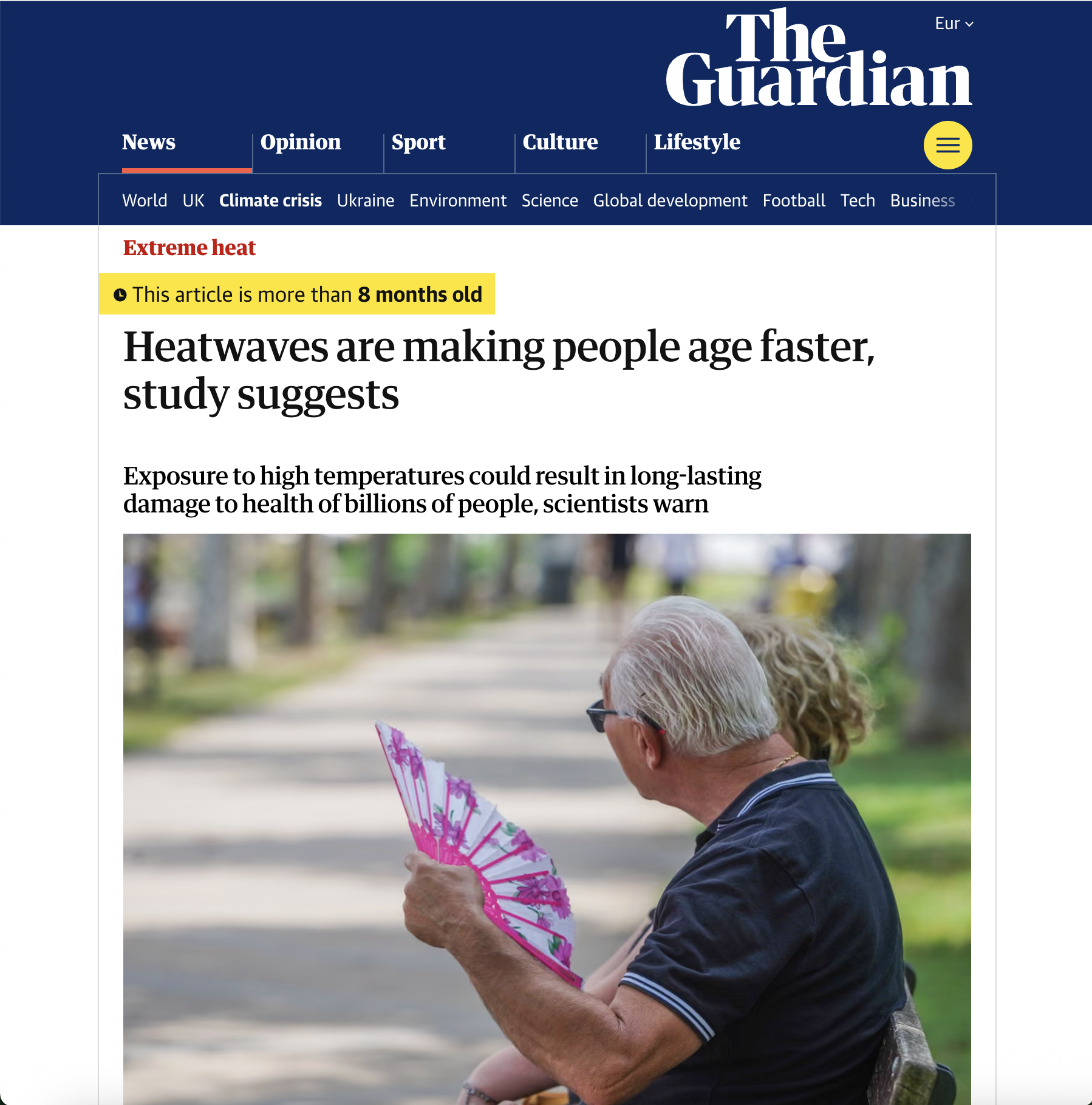

From a public health standpoint, shade reduces heat stress and exposure to direct solar radiation, making outdoor activity safer. This is especially important for cities where exposure to the sun can quickly turn a simple walk, a playground visit, or a wait at a bus stop into an uncomfortable and potentially unsafe experience. Public health guidance also reminds us that heat does not affect everyone equally. Older adults, young children, outdoor workers, people with disabilities, and people with certain health conditions are way more vulnerable to heat-related illness.
In that sense, shade grants the most vulnerable segments of society the right to use public space. Shouldn’t our elderly and our children have the right to enjoy our streets, parks, plazas, waterfronts, and markets? Shouldn’t they be able to sit, walk, play, socialize, and be part of public life without being pushed indoors by direct sunlight and extreme heat?
This is especially important when we consider how central healthy lifestyles are for both groups. We often speak about encouraging children to play outdoors, and encouraging older residents to stay active, walk more, and remain socially connected. But these ambitions become much harder to achieve when the public realm itself is not designed to support them.
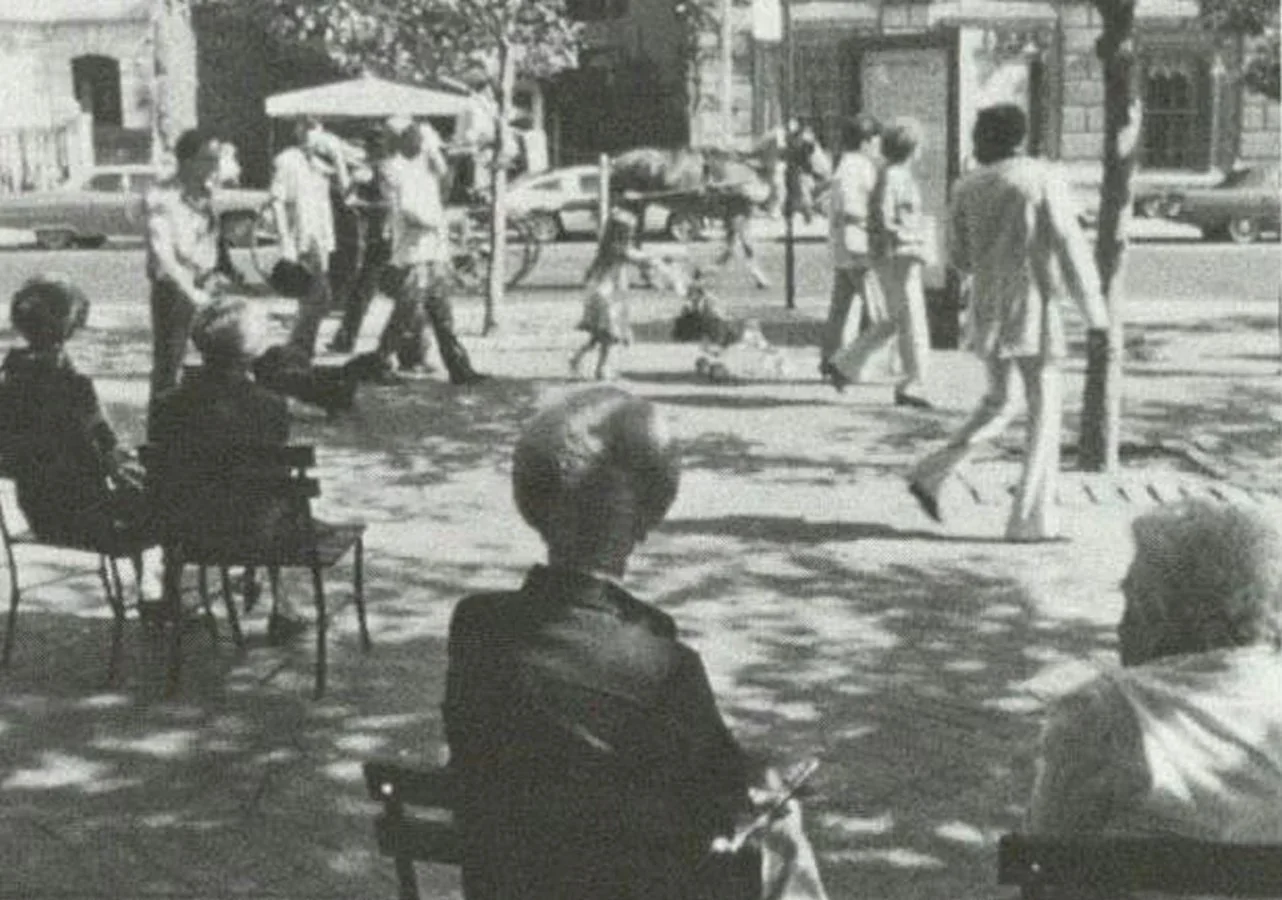
William H Whyte extensively highlighted the importance of shade in his book and film, The Social Life of Small Urban Spaces. A timeless classic in urbanist literature!
Here, we understand that shade is not simply about comfort, it is about access. A park without shaded seating, a playground without shaded equipment, a plaza without shaded edges, or a bus stop without proper protection from the sun may technically be public, but it is not equally usable by everyone. The people most affected are often those who need public space the most: children, elderly residents, outdoor workers, public transport users, and people who cannot move from one air-conditioned interior to another.
The point is not that shade alone can solve the challenge of heat. But without it, many of our urban ambitions become theoretical. Walkability becomes theoretical. Healthy lifestyles become theoretical. Public parks become seasonal. Public transport becomes less dignified. And public space becomes something that is available only to those who can endure exposure, or avoid it altogether.
What is interesting is that this idea is not foreign to the Gulf. In fact, I have written and spoken extensively about how traditional urbanism in the region was far more climate-responsive than many of the urban environments we produce today. The compactness of older Gulf settlements was not accidental. Narrow streets, sikkas, courtyards, arcades, shaded thresholds, and closely built structures all worked together to reduce exposure, create shade, and make everyday movement more tolerable.
In the traditional Khaleeji city, shade was embedded into the urban form itself. The street was often narrow enough for buildings to shade one another. The courtyard allowed homes to manage light, air, privacy, and heat. The sikka created a pedestrian route that was human-scaled and partially protected from the sun. Arcades and covered edges allowed people to move, trade, pause, and socialize without being fully exposed. This was not “beautification.” It was environmental intelligence expressed through urban form.
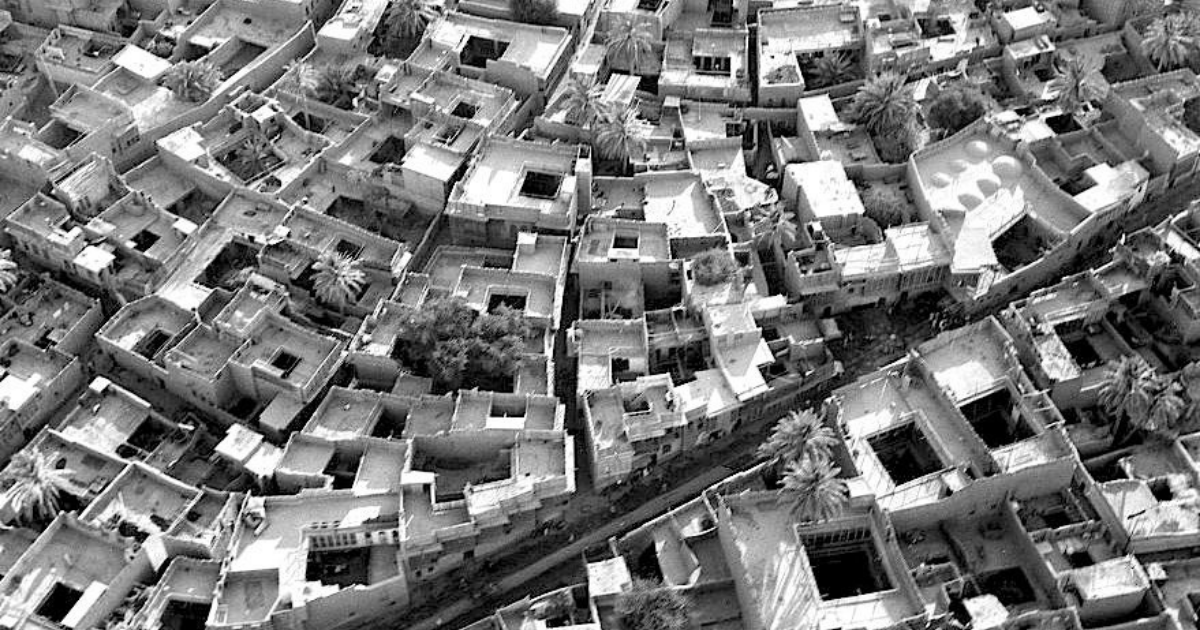
Aerial view of a residential neighborhood in Baghdad, Iraq. Photographed between 1920-34. (Granger Historical Picture Archive)
This is why the current condition is ironic. We often speak about heat as if it is the reason Gulf cities cannot be walkable, but our own urban history suggests something more nuanced. The Gulf solved heat by designing exposure carefully. We created shade through proximity, enclosure, orientation, and the relationship between buildings and streets. Today, we chose to solve heat by ignoring outdoor conditions.
Modern planning, unfortunately, moved us in the opposite direction. Wide roads, large setbacks, exposed parking lots, isolated buildings, and fragmented land uses have created a city where the pedestrian is often left unprotected. Instead of buildings shading streets, buildings are pulled away from them. Instead of continuous frontage, we get gaps. Instead of shaded routes, we get exposed crossings, boundary walls, service roads, and asphalt surfaces that absorb and radiate heat.
Of course I recognize that the answer is not to nostalgically recreate the old city. Contemporary urban living has different densities, household structures, and infrastructure needs. But there is a lesson worth recovering: shade cannot be treated as an afterthought. Traditional Khaleeji urbanism understood shade as part of the basic operating system of the city.
This is where the discussion needs to move from shaded moments to a shading network. A single canopy, a few trees, or a shaded bench can help, but they do not fundamentally change how people move through the city. What matters is continuity. If we want walking, waiting, playing, and gathering to become realistic parts of everyday urban life in the Khaleeji city, then shade must be planned as a connected system across streets, parks, transit stops, schools, mosques, markets, waterfronts, and neighborhood centers. The question is not simply where we can add shade, but how we can stitch shaded routes into the structure of the city itself.
If shade is to be treated as public infrastructure, then it cannot be delivered through scattered interventions alone. What we need is a holistic shading network, a connected system of shaded streets, crossings, parks, transit stops, school routes, mosque surroundings, and neighborhood centers. The goal should not simply be to add shade wherever we can, the goal should be to plan shade with the same seriousness that we plan roads, utilities, drainage, and public transport. Shade should be mapped, regulated, designed, maintained, and measured. It should become part of how we judge whether a street or public space actually works.
1
The first step is to understand where exposure is most severe. Khaleeji cities should adopt a solar radiation zoning map that identifies the streets, public spaces, and pedestrian routes most exposed to direct sunlight and radiant heat. This would allow planners to move from general statements about “hot streets” to a more precise understanding of where shade is most urgently needed. It would also allow building regulations to respond to climate more directly. Instead of treating buildings as isolated objects on individual plots, regulations could ask how buildings contribute to the comfort of the street.
This is where a more climate-responsive form-based code becomes useful. A form-based code would not only regulate land use or setbacks, but also the relationship between building massing, street enclosure, arcades, overhangs, colonnades, and pedestrian comfort. Shade does not need to come only from add-on canopies. It can be produced by the building itself. The massing of a building, its frontage, its height-to-street-width ratio, its arcade, and its relationship to the sidewalk can all contribute to a cooler and more comfortable public realm.
Research on urban canyon geometry shows that street orientation, building height, and street width influence solar exposure, surface heating, airflow, and thermal comfort. In hot and arid climates, shading surfaces from direct solar radiation is one of the most important strategies for reducing heat load.
2
The second component is the street network itself. In new neighborhood plans and masterplanned projects, street orientation should not be treated as a purely geometric or traffic-engineering exercise. It should account for solar radiation. Streets should be oriented, wherever possible, in ways that allow buildings to shade one another and reduce the amount of direct sun hitting the pedestrian realm. This does not mean that every street can be perfectly oriented, but it does mean that solar exposure should be part of the design process from the beginning, not something discovered after construction.
Street width matters too. One of the lessons from traditional Gulf urbanism is that narrow streets are not just charming; they are climatically intelligent. Local roads should generally be kept narrow, human-scaled, and shaded. Collector roads should also be made narrower where traffic safety, emergency access, utilities, and infrastructure requirements allow. Wider roads mean more asphalt, longer crossings, more exposed surfaces, and less shade from adjacent buildings. They also make walking feel psychologically and physically more difficult. A street that is too wide may move cars efficiently, but it often punishes the pedestrian.
3
The third component is trees. Trees are essential to any shading network, especially once they mature. They provide shade, soften the public realm, reduce surface temperatures, and improve the experience of walking and lingering outdoors. Vegetation can contribute meaningfully to thermal comfort in hot-arid cities. But we have to be honest about trees in Qatar.
Not every street can or should become a heavily planted boulevard. Greening can become counterproductive if it depends on excessive irrigation, unsuitable species, poor soil conditions, or maintenance systems that are not realistic in the long term. Native and adaptive planting should be prioritized, but native plants also have limitations when it comes to producing dense shade. So trees should be a key part of the shading network, but they cannot be the only strategy. In arid cities, a serious shade policy has to combine landscape shade with built shade.
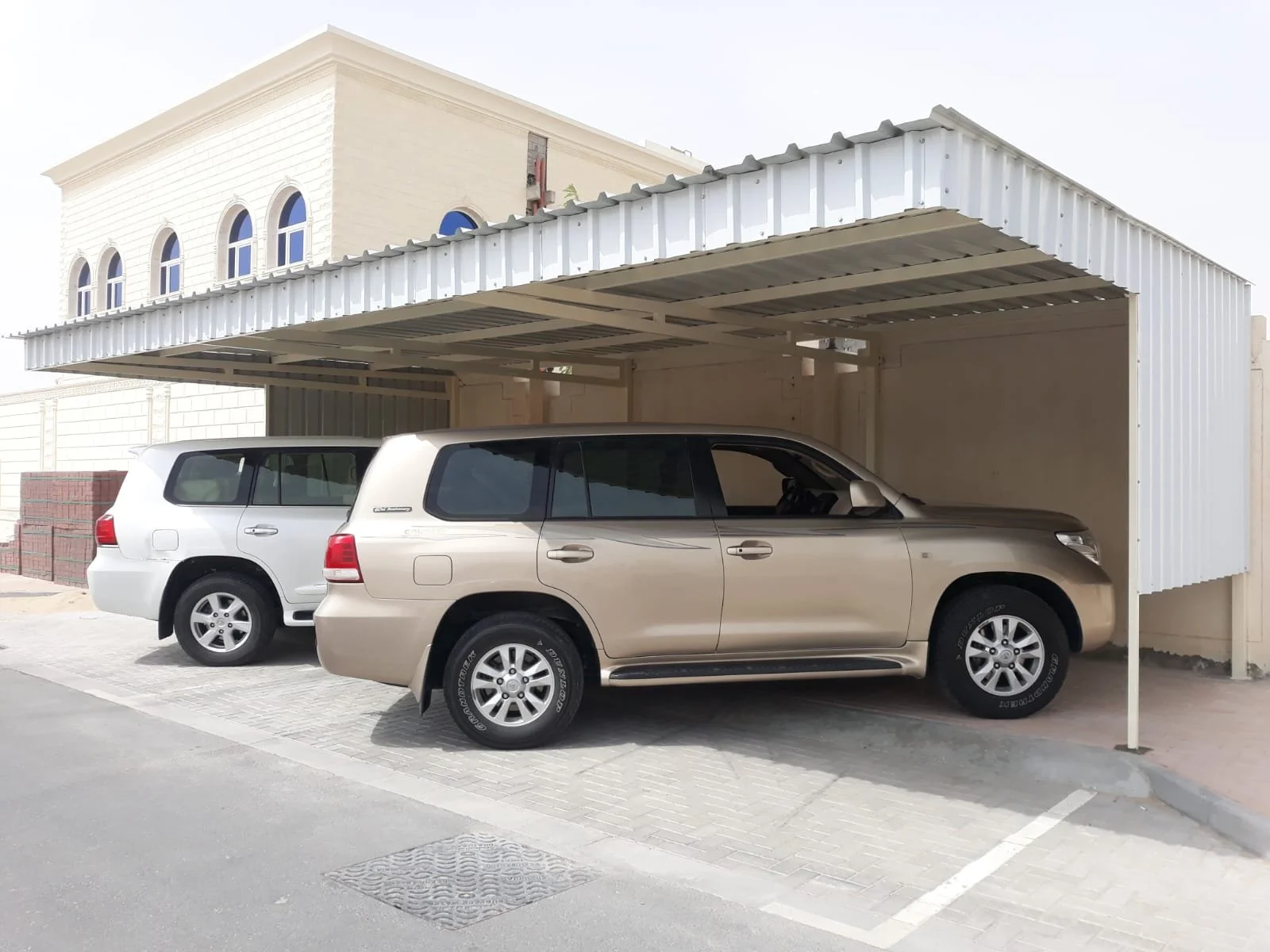
An ordinary sight in Qatar’s suburbs…
4
The fourth component is shading structures. This includes tensile fabric canopies, retractable umbrella systems, pergolas, trellis systems, shaded walkways, colonnades, and solar panel canopies. These are not experimental ideas. We already use shade structures everywhere in Qatar, especially to protect parked cars. Our streets, houses, schools, mosques, and commercial areas are littered with canopies designed to protect vehicles from the sun. But it raises a simple question: if we are willing to shade unfeeling hunks of steel, should we not be even more willing to shade human beings?
There is also an opportunity here to make shade multifunctional. Solar panel canopies, for example, can provide shade while generating energy. Pergolas and trellis systems can support planting where appropriate. Retractable systems can respond to seasonal changes. Tensile structures can shade playgrounds, plazas, and pedestrian routes without requiring large building footprints. In other words, shade structures should not be treated as temporary fixes or visual clutter. If designed properly, they can become part of the civic identity of hot-climate cities.
A shading network would therefore need four main layers: a mapping layer, a regulatory layer, a street-design layer, and a delivery layer. The mapping layer identifies exposure and priority routes. The regulatory layer uses tools such as solar radiation zoning and form-based codes to ensure buildings contribute to shade. The street-design layer aligns street orientation, width, crossings, and public-realm standards with thermal comfort. The delivery layer combines trees, built shade, solar canopies, arcades, pergolas, and maintenance systems into one connected network.
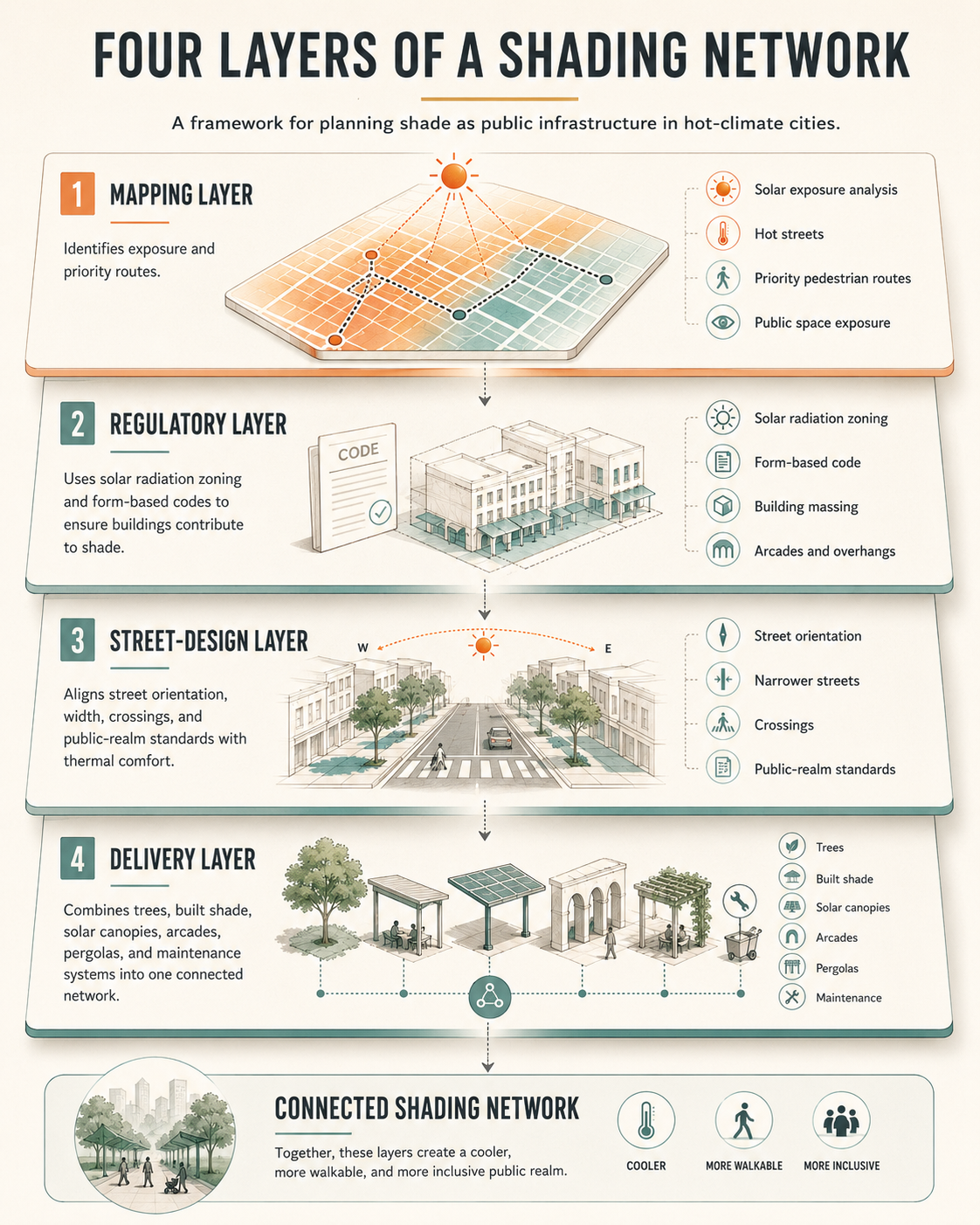
A graphic generated by ChatGPT on the proposed four layer framework.
The key word here is connected. A shaded bus stop is good, but a shaded route to the bus stop is better. A shaded playground is good, but a shaded walk from the surrounding homes to that playground is better. A shaded plaza is good, but shaded edges, shaded crossings, and shaded links to nearby streets are what make it part of everyday urban life. The ambition should be to create shade continuity, especially along the routes people use most: between homes and mosques, homes and schools, homes and parks, metro stations and destinations, parking areas and public buildings, and commercial streets and surrounding neighborhoods.
This is the shift I am arguing for. Shade should not be understood as an object. It should be understood as a network. Once we see it that way, we can begin to ask better planning questions: Which routes are most exposed? Which communities are most vulnerable? Which streets should be prioritized first? Which regulations prevent buildings from shading the public realm? Which areas need trees, and which need built shade? Which public investments can deliver the greatest improvement in comfort, access, and everyday usability?
In the Gulf, we can’t afford to keep these questions secondary. They are central to whether we can make healthy urban living possible, and have a functioning public realm. A shading network would not make the climate disappear. But it would make the city more negotiable, more humane, and more usable. It would allow walkability, public health, transit use, and public life to move from aspiration to practice.
Similar to my last blog post, I have also created a carousel on Instagram summarizing the article, please check it out on my Instagram.